
The photoresistive conductive polymer: an innovation in conductive materials
DOI:
https://doi.org/10.5902/2179460X92188Keywords:
Conductive polymer, Photoresistive, Nanomaterials, Sensors, Flexible electronicsAbstract
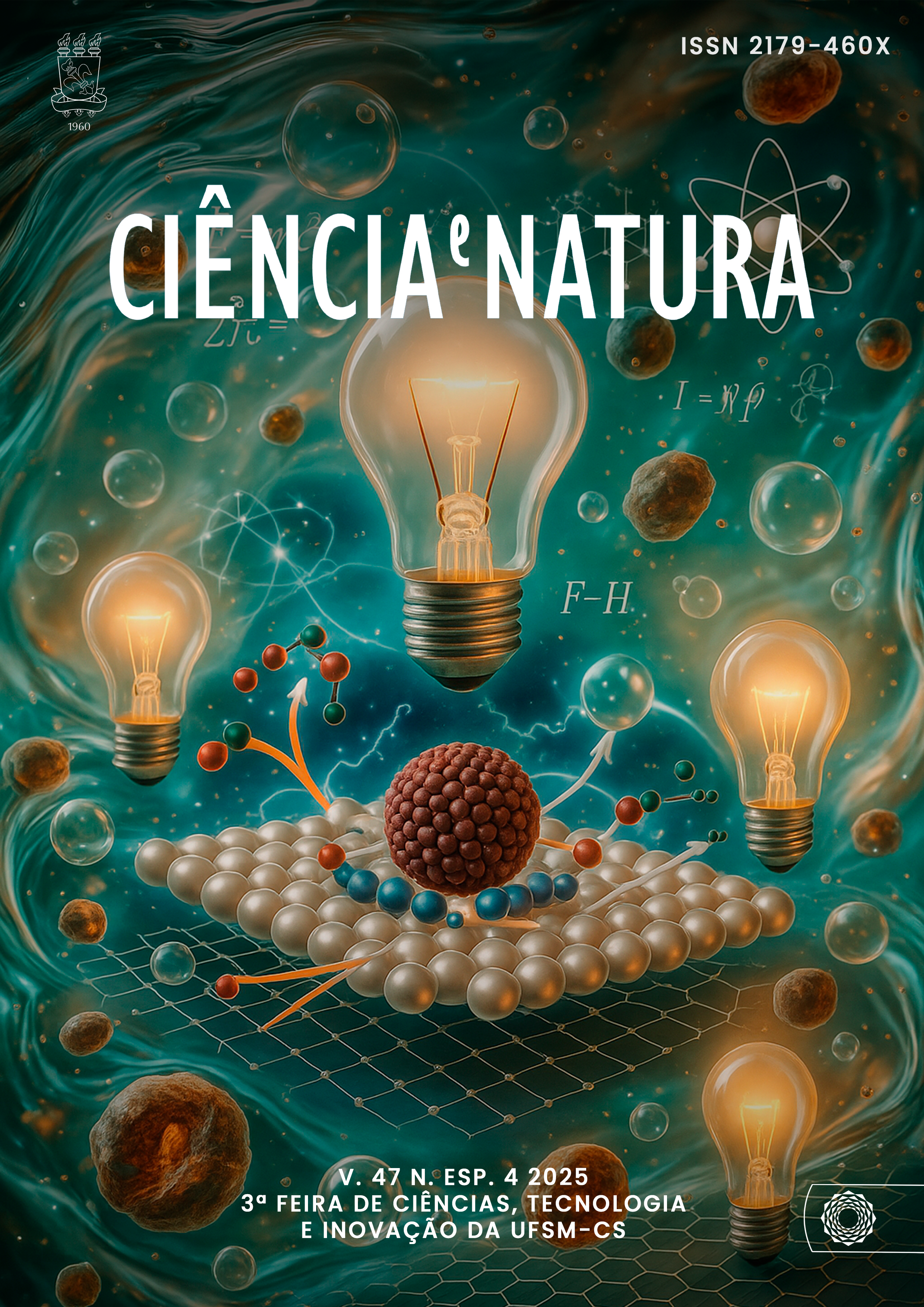
The development of functional polymers represents a highly promising yet still largely unexplored field. The ability of simple polymers to perform functions beyond their traditional characteristics opens new frontiers in materials science. This study presents an alternative approach to the fabrication of conductive polymers with energy-related properties by combining accessible and environmentally safe materials. The innovation lies in the use of iron-based nanoparticles mixed with a PVA (white glue) polymer matrix, resulting in a flexible compound, similar to natural rubber, with semiconductive properties. In this research, the electrical resistance behavior of the material under infrared light exposure was analyzed, revealing a photoresistive effect similar to that of LDR devices, with resistance decreasing as the wavelength of the applied light increased. These characteristics make the material promising for applications in sensors, energy storage devices, and flexible electronic components, with potential for low-cost, large-scale industrial replication.
Downloads
References
Carter, L. (2024). Emerging trends in conductive polymers: Transforming electronics and energy storage. Journal of Polymer Science, 9, 24, URL https://www.primescholars.com/articles/emerging-trends-in-conductive-polymers-transforming-electronics-and-energy-storage-130756.html.
Feynman, R. P. (1960). There’s plenty of room at the bottom. Em: Annual Meeting of the American Physical Society, URL https://www.caltech.edu/about/news/plenty-room-bottom-48695, original lecture delivered in 1959 at Caltech.
Franco, G. M., dos Santos Kremer, I., Vieira, M. C. C., Rigue, J. N., Boita, J. (2025). Multifunctional polymers: A new frontier in conductivity and energy generation for advanced electronics. Next Materials, 6, 100,476, URL https://doi.org/10.1016/j.nxmate.2024.100476.
Martinez, S. (2024). Advancements in conductive polymers: Applications and future directions. Journal of PolymerScience, 9, 030, URL https://www.primescholars.com/articles/advancements-in-conductive-polymers-applications-and-future-directions-130760.html.
Mehra, A., Chaudhary, M., De Souza, F., Gupta, R. K. (2024). Recent advancements in conducting polymers for biomedical sensors. Em: Gupta, R. K. (ed) NanoCarbon: A Wonder Material for Energy Applications, Springer, Singapore, p Chapter 18.
Murugan, K., Jeyamohanaroopan, K. M. K., Navaneethanath, M., Prakash, M., Ajithkumar, R. (2020). Computerized smart luminous system using passive infrared by motion recognition (csls-wifi). Em: Proceedings of the International Conference on Innovative Science and Technology, URL https://doi.org/10.1109/ICISC47916.2020.9171201.
Paari-Molnar, E., Kardos, K., Told, R., Simon, I., Sahai, N., Szabo, P., Bovari-Biri, J., Steinerbrunner-Nagy, A., Pongracz, J. E., Rendeki, S., Maroti, P. (2024). Comprehensive study of mechanical, electrical and biological properties of conductive polymer composites for medical applications through additive manufacturing. Polymers, 16(18), 2625.
Taniguchi, N. (1974). On the basic concept of ’nano-technology’. Proceedings of the International Conference on Production Engineering, pp. 18–23.
WatElectronics (2019). Light dependent resistor (ldr) – working principle and its applications. https://www.watelectronics.com/light-dependent-resistor-ldr-with-applications/, URL https://www.watelectronics.com/light-dependent-resistor-ldr-with-applications/, accessed: 2025-05-25.
Downloads
Published
Issue
Section
License
Copyright (c) 2025 Ciência e Natura

This work is licensed under a Creative Commons Attribution-NonCommercial-ShareAlike 4.0 International License.
To access the DECLARATION AND TRANSFER OF COPYRIGHT AUTHOR’S DECLARATION AND COPYRIGHT LICENSE click here.
Ethical Guidelines for Journal Publication
The Ciência e Natura journal is committed to ensuring ethics in publication and quality of articles.
Conformance to standards of ethical behavior is therefore expected of all parties involved: Authors, Editors, Reviewers, and the Publisher.
In particular,
Authors: Authors should present an objective discussion of the significance of research work as well as sufficient detail and references to permit others to replicate the experiments. Fraudulent or knowingly inaccurate statements constitute unethical behavior and are unacceptable. Review Articles should also be objective, comprehensive, and accurate accounts of the state of the art. The Authors should ensure that their work is entirely original works, and if the work and/or words of others have been used, this has been appropriately acknowledged. Plagiarism in all its forms constitutes unethical publishing behavior and is unacceptable. Submitting the same manuscript to more than one journal concurrently constitutes unethical publishing behavior and is unacceptable. Authors should not submit articles describing essentially the same research to more than one journal. The corresponding Author should ensure that there is a full consensus of all Co-authors in approving the final version of the paper and its submission for publication.
Editors: Editors should evaluate manuscripts exclusively on the basis of their academic merit. An Editor must not use unpublished information in the editor's own research without the express written consent of the Author. Editors should take reasonable responsive measures when ethical complaints have been presented concerning a submitted manuscript or published paper.
Reviewers: Any manuscripts received for review must be treated as confidential documents. Privileged information or ideas obtained through peer review must be kept confidential and not used for personal advantage. Reviewers should be conducted objectively, and observations should be formulated clearly with supporting arguments, so that Authors can use them for improving the paper. Any selected Reviewer who feels unqualified to review the research reported in a manuscript or knows that its prompt review will be impossible should notify the Editor and excuse himself from the review process. Reviewers should not consider manuscripts in which they have conflicts of interest resulting from competitive, collaborative, or other relationships or connections with any of the authors, companies, or institutions connected to the papers.

