Vol. 3 No. 1 e 2 (2012): Estudos sobre Schopenhauer – Eds. 05/06
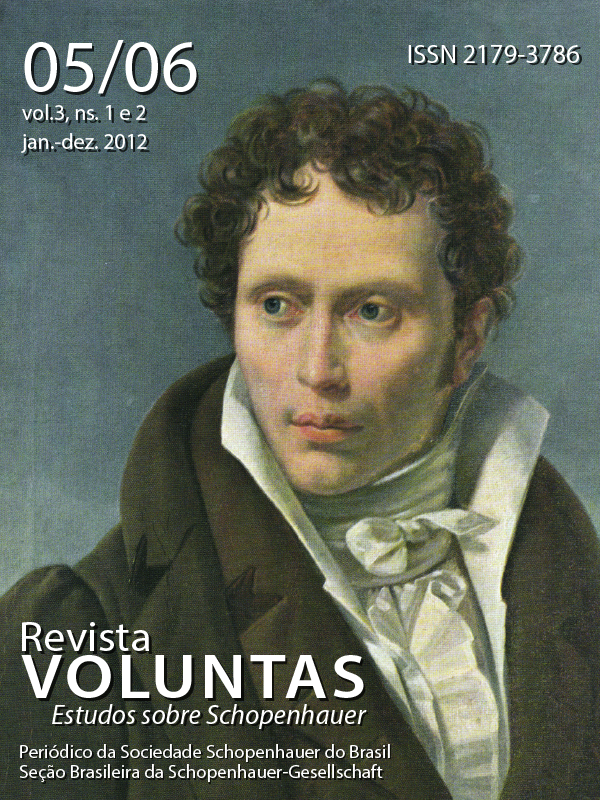
Capa Voluntas v.3, ns.1 e 2
Published: 2012-07-01

Editorial

  • Editorial

    Vilmar Debona
    01-02
    DOI: https://doi.org/10.5902/2179378634270

Around Schopenhauerian eudemonology

  • “Prudentia” and the practical use of reason by Schopenhauer

    Jorge Luiz Viesenteiner
    03-19
    DOI: https://doi.org/10.5902/2179378633986
  • Schopenhauer and the Cynics: elements of cynicism in schopenhauerian eudemonology

    Leandro Chevitarese
    20-29
    DOI: https://doi.org/10.5902/2179378633987
  • The society as will and representation: The theory of society in schopenhauerian eudemonology

    Juan David Mateu Alonso
    30-60
    DOI: https://doi.org/10.5902/2179378633990
  • No "accommodation": Deussen and Hartmann against Schopenhauer's eudemonology

    Giuseppe Invernizzi
    61-74
    DOI: https://doi.org/10.5902/2179378633992

Schopenhauerian Studies (Continuous Flow)

  • The strategic use of Schopenhauer made by Nietzsche in "On Genealogy of morals"

    Antonio Edmilson Paschoal
    75-90
    DOI: https://doi.org/10.5902/2179378633995
  • Schopenhauer as educator: the sketch of Nietzsche's philosophical misanthropy

    Jarlee Salviano
    91-100
    DOI: https://doi.org/10.5902/2179378633996
  • Schopenhauer and the imprecation against the intellectual corruption of the university philosophy: a polemic extemporaneous

    Renato Nunes Bittencourt
    101-109
    DOI: https://doi.org/10.5902/2179378633997
  • Schopenhauer and the secular foundation of ethics

    Fabio Ciracì
    111-121
    DOI: https://doi.org/10.5902/2179378633998
  • Criminalization and self-control as "ruse of the conscious will" for Eduard von Hartmann

    Ignace Haaz
    122-142
    DOI: https://doi.org/10.5902/2179378634002
  • The formulation of the doctrines of the State and of the Entitlement developed by young Schopenhauer: extension, limits and changes regarding to the publication of his masterwork

    Felipe dos Santos Durante
    143-155
    DOI: https://doi.org/10.5902/2179378634006
  • A "predecessor" of Schopenhauer: Giulio Cesare Vanini

    Mario Carparelli
    156-165
    DOI: https://doi.org/10.5902/2179378634007
  • A critique "Neoplatonic" of traditional metaphysics - Or: the statute of the pure intuition and its grounds from removal method in Schopenhauer

    Manuel Moreira da Silva
    166-186
    DOI: https://doi.org/10.5902/2179378634008
  • Karl Kraus reader of Schopenhauer

    Maria Vitale
    187-194
    DOI: https://doi.org/10.5902/2179378634009
  • Organic and inorganic "On the will in nature"

    Ana Carolina Soliva Soria
    195-202
    DOI: https://doi.org/10.5902/2179378634025
  • Schopenhauer and the ties between will, intuition and rationality

    Eduardo Ribeiro da Fonseca
    203-210
    DOI: https://doi.org/10.5902/2179378634026
  • In the spirit of music: for a thesis about the tragic synthesis in Schopenhauer and Wagner

    Luan Corrêa da Silva
    211-223
    DOI: https://doi.org/10.5902/2179378634027
  • The Proximity of Genius and Madness: A Study of Schopenhauer's Aesthetics

    Samuel Green
    224-250
    DOI: https://doi.org/10.5902/2179378634028
  • Schopenhauer as theoretical of the virtue

    Luciana Samamé
    251-264
    DOI: https://doi.org/10.5902/2179378634037
  • On the problem of moral freedom in Hume and Schopenhauer

    Rogério Moreira Orrutea Filho
    265-290
    DOI: https://doi.org/10.5902/2179378634040
  • The genesis of the system of Transcendental Philosophy of Schopenhauer

    Alexandre Teles
    291-325
    DOI: https://doi.org/10.5902/2179378634042

Translations

Reviews

  • Philosophie des Leibes. Die Anfänge bei Schopenhauer und Feurbach. Hrsg. von Matthias Koβler und Michael Jeske

    Fabio Ciracì
    348-351
    DOI: https://doi.org/10.5902/2179378634070
  • A concepção de matéria na obra de Schopenhauer, de Eduardo Brandão

    Daniel Quaresma F. Soares
    352-358
    DOI: https://doi.org/10.5902/2179378634072
  • Introdução a Schopenhauer, de Adolphe Bossert

    Mônica Saldanha Dalcol
    359-361
    DOI: https://doi.org/10.5902/2179378634073