Pesimismo crítico, progreso y regresión social: el déficit schopenhaueriano de la teoría crítica
DOI:
https://doi.org/10.5902/2179378695031Palabras clave:
Pesimismo crítico, Teoría crítica, Progreso, Regresión social, Schopenhauer, HorkheimerResumen
A diferencia de los fundadores de la Escuela de Fráncfort —especialmente Horkheimer y Adorno—, la mayoría de los representantes contemporáneos de la teoría crítica tienden a pasar por alto a Schopenhauer y el potencial crítico y emancipador de su pesimismo inconformista y antiteleológico. ¿Podría este descuido albergar implícitamente una clave para comprender lo que hoy se denomina el «agotamiento de la teoría crítica», particularmente en lo que respecta a los diagnósticos de la actualidad sobre la regresión política y social? Este artículo se propone desarrollar reflexiones preliminares sobre posibles diálogos entre las premisas de la filosofía schopenhaueriana y la teoría crítica contemporánea, concretamente la obra de Rahel Jaeggi en su libro más reciente, *Fortschritt und Regression* (2023). En conclusión, el artículo sostiene que, al igual que las propuestas de Amy Allen y Rahel Jaeggi —quienes abogan, respectivamente, por un retorno a Foucault y Adorno, y a Benjamin y Adorno—, un retorno aún inexplorado a Horkheimer y Schopenhauer podría contribuir a la teoría crítica frente a sus desafíos actuales.
Descargas
Citas
Adorno, T. W. Minima Moralia: Reflections from Damaged Life. Tr. by E. F. N. Jephcott. London: Verso, 1978.
Adorno, T. W. Negative Dialectics. Tr. by E. B. Ashton. London: Routledge, 2004.
Adorno, T. W. Progress. Tr. by Eric Krakauer, in: Benjamin: Philosophy, Aesthetics, History. Ed. By Gay Smith. Chicago: University of Chicago Press, 1989, pp. 84-101.
Allen, A. The End of Progress: decolonizing the normative foundations of critical theory. New York: Columbia University Press, 2016.
Benjamin, W. “Surrealism: The Last Snapshot of the European Intelligentsia”, in One Way Street and Other Writings, tr. Edmund Jephcott and Kingsley Shorter. London: NLB, pp. 225-39, 1979.
Buril, B. Reseña de The End of Progress, de Amy Allen. Constelaciones: Revista de Teoría Crítica. N. 8/9, 2016/2017.
Chade, J. Armados até os dentes, Carta Capital, São Paulo, 23 de julho de 2025.
Ciracì, F. Sul razzismo: Strutture logiche e paradigmi storico-filosofici. Milano: Mimesis, 2024.
Fazio, D. M. La doppia faccia del pessimismo, Cuadernos de Pesimismo, México, n. 2, p. 109-123, 2023.
Fazio, G. Ritorno a Francoforte: le avventure della nuova teoria critica. Roma: Castelvecchi, 2020.
Habermas, J. Bemerkungen zur Entwicklungsgeschichte des Horkheimerschen Werkes, in Max Horkheimer Heute: Werk und Wirkung, hrsg. A. Schmidt & N. Altwicker. Frankfurt a.M: Fischer Verlag, 1986, pp. 163-179.
Hegel, G.W.F. Letter of 13 October 1806 to F. I. Niethammer, no. 74, p. 119, in Briefe von und an Hegel ed. Hoffmeister, vol. 1, 1970.
Heidtmann, B. Pessimismus und Geschichte. Zur kritischen Philosophie Schopenhauers. In: Schopenhauer und Marx: Philosophie des Elends – Elend der Philosophie. Hrsg. Hans Ebeling; Ludger Lütkehaus. Frankfurt a.M.: Syndikat, 1985.
Horkheimer, M.; Adorno, T. W. Dialectic of Enlightenment: Philosophical Fragments. Ed. Gunzelin Schmid Noerr. Tr. Edmund Jephcott. Stanford: Stanford University Press, 2002.
Horkheimer, M. Critical Theory: Selected Essays. Tr. Matthew J. O’Connell. New York: Continuum, 2002.
Horkheimer, M. Gesammelte Schriften. 19 Bdn. Hrsg. von Alfred Schmidt u. Gunzelin S. Noerr. Frankfurt a.M.: Fischer Verlag, 1985-1996.
Horkheimer, M. Schopenhauer und die Gesellschaft (p. 43-54), Die Aktualität Schopenhauers (p. 122-142), Pessimismus heute (p. 224-232). In: Horkheimer, M. Gesammelte Schriften. Bd. 7. Hrsg. von Alfred Schmidt u. Gunzelin S. Noerr. Frankfurt a.M.: Fischer, 1985-1996.
Jaeggi, R. Fortschritt und Regression. Berlin: Suhrkamp, 2023.
Jaeggi, R. Progresso e regressione. Ed. a cura di Giorgio Fazio. Trad. di Francesco Ferrari. Roma: Castelvecchi, 2025.
Konder, L. Introdução ao fascismo. 2ª ed. São Paulo: Expressão Popular, 2009.
Löwy, M.; Varikas, E. “The world spirit on the fins of a rocket”. Adorno’s critique of Progress. Tr. by. Martin Ryle. Radical Philosophy 70, pp. 9-15, March/April 1995.
Lukács, G. Die Zerstörung der Vernunft. Der Weg des Irrationalismus von Schelling zu Hitler. Vol. 1. 4th ed. Berlin: Aufbau, 1988.
Lütkehaus, L. (2007) “Esiste una sinistra schopenhaueriana? Ovvero: il pessimismo è un quietismo?”, pp. 15-34, in Arthur Schopenhauer e la sua scuola, ed. Fabio Ciracì, Domenico M. Fazio, and Francesca Pedrocchi. Lecce: Pensa MultiMedia.
Ruggieri, D. “Schopenhauer’s Legacy and Critical Theory. Reflections on Max Horkheimer’s Unpublished Archive Material”. Schopenhauer-Jahrbuch 96, Würzburg, 2015, pp. 93-108.
Schmidt, A. Die geistige Physiognomie Max Horkheimers. In Drei Studien über Materialismus. Schopenhauer, Horkheimer, Glücksproblem, pp. 81-134. München: Carl Hanser Verlag, 1977b.
Schmidt, A. Schopenhauer und der Materialismus. In Drei Studien über Materialismus. Schopenhauer, Horkheimer, Glücksproblem, pp. 21-80. München: Carl Hanser Verlag, 1977a.
Schopenhauer, A. Gespräche. Hrsg. von Arthur Hübscher. Stuttgart-Bad Cannstatt: Fromman, 1971.
Schopenhauer, A. Parerga and Paralipomena: Short Philosophical Essays. Vol. 2. Ed. and tr. Adrian del Caro and Christopher Janaway. Cambridge: Cambridge University Press, 2015.
Schopenhauer, A. Sämtliche Werke. Hrsg. von Paul Deussen. 16 Bdn. München: Piper Verlag, 1911-1941. In: Schopenhauer, A. “Schopenhauer im Kontext III” - Werke, Vorlesungen, Nachlass und Briefwechsel auf CD-ROM (Release 1/2008).
Schopenhauer, A. The World as Will and Representation. Vol. 2. Ed. and tr. Christopher Janaway et al. Cambridge: Cambridge University Press, 2018.
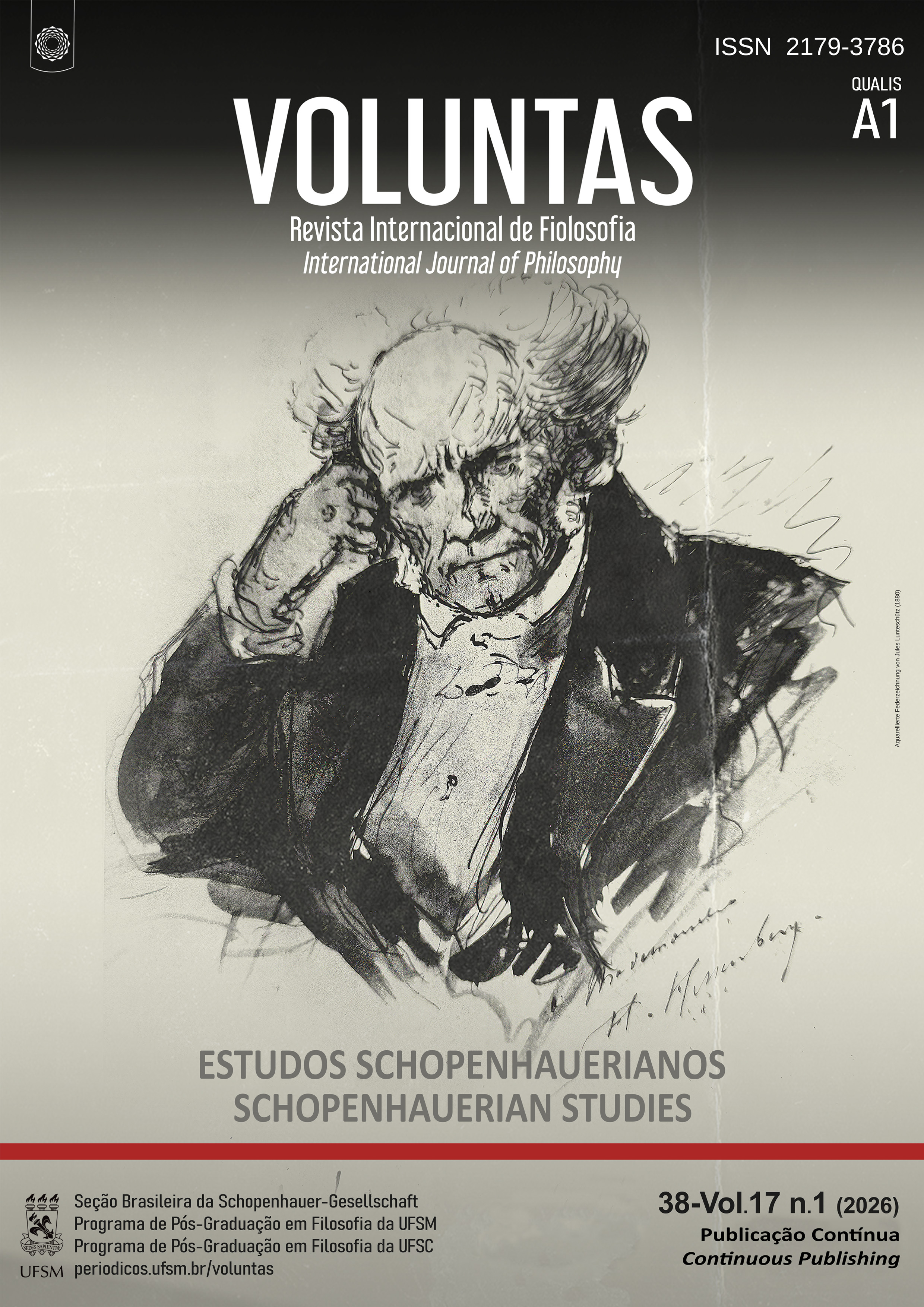
Descargas
Publicado
Número
Sección
Licencia
Derechos de autor 2026 Vilmar Debona

Esta obra está bajo una licencia internacional Creative Commons Atribución-NoComercial-CompartirIgual 4.0.
La sumisión de los originales para este periódico implica la transferencia, por parte de autores, de los derechos de publicación impresa y digital. Los derechos autorales para los artículos publicados son del autor, con derechos del periódico sobre la primera publicación. Los autores sólo podrán utilizar los mismos resultados en otras publicaciones indicando claramente este periódico como el medio de publicación original. En virtud de ser un periódico de acceso abierto, está permitido el uso gratuito de los artículos en aplicaciones educacionales, científicas, no comerciales, desde que referenciada la fuente (por favor, vea la licencia Creative Commons en el pie de página de este periódico).