O antinatalismo benatariano e o pessimismo metafísico de Schopenhauer
DOI:
https://doi.org/10.5902/2179378688376Palavras-chave:
Antinatalismo, Benatar, Metafísica, SchopenhauerResumo
O presente artigo tem como objetivo analisar como o conceito de antinatalismo – isto é, uma visão filosófica que defende a ideia de que é melhor que os humanos parem de trazer novas vidas ao mundo, ou que teria sido melhor não termos sido trazidos à existência – e, mais especificamente, o antinatalismo de David Benatar, se alinham à vertente metafísica do pessimismo schopenhaueriano, presente no Tomo I de O Mundo como Vontade e Representação e também nos Suplementos. Ao fazer isto, não será intenção deste trabalho a pressuposição de que as vertentes do pessimismo de Schopenhauer sejam, necessariamente, antinatalistas. Antes, tem-se como motivação demonstrar o que há do pessimismo metafísico schopenhaueriano no antinatalismo de Benatar que, por ser diferente de outras visões antinatalistas, é aqui adjetivado como “benatariano”, e, por conseguinte, o que há na posição do filósofo sul-africano que pode ser justificado pela metafísica de Schopenhauer.
Downloads
Referências
BEISER, F. C. Weltschmerz: Pessimism in German Philosophy, 1860-1900. New York: Oxford University Press, 2016. DOI: https://doi.org/10.1093/acprof:oso/9780198768715.001.0001
BENATAR, D. Better never to have been: the harm of coming to existence. New York: Oxford University Press, 2006. DOI: https://doi.org/10.1093/acprof:oso/9780199296422.001.0001
BENATAR, D. The human predicament: a candid guide to life’s biggest questions. New York: Oxford University Press, 2017. DOI: https://doi.org/10.1093/acprof:oso/9780190633813.001.0001
CACCIOLA, M. L. M. O. A questão do finalismo da filosofia de Schopenhauer. Discurso, São Paulo, v. 20, p. 77-98, 1993. Disponível em: https://doi.org/10.11606/issn.2318-8863.discurso.1993.37957. Acesso em 2 jan. 2023. DOI: https://doi.org/10.11606/issn.2318-8863.discurso.1993.37957
CACCIOLA, M. L. M. O. Schopenhauer e a questão do dogmatismo. São Paulo: Edusp, 1994.
CACCIOLA, M. L. M. O. Schopenhauer é um verdadeiro discípulo de Kant? Revista de Filosofia Aurora. Curitiba, v. 30, n. 49, p. 8-17, 2018. Disponível em: https://doi.org/10.7213/1980-5934.30.049.PR01. Acesso em 15 abr. 2023. DOI: https://doi.org/10.7213/1980-5934.30.049.PR01
FERREIRA, T.; DEBONA, V. Schopenhauer e a fome. Voluntas: Revista Internacional de Filosofia, Santa Maria, v. 14, n. 1, e86368, p. 1-24, 2024. Disponível em: https://doi.org/10.5902/2179378686368. Acesso em: 2 abr. 2024. DOI: https://doi.org/10.5902/2179378686368
DEBONA, V. A grande e a pequena ética de Schopenhauer. ethic@, Florianópolis, vol. 14, n. 1, pp. 36-56, 2015. Disponível em: https://doi.org/10.5007/1677-2954.2015v14n1p36. Acesso em 25 fev. 2024. DOI: https://doi.org/10.5007/1677-2954.2015v14n1p36
DOSSENA, F. O mal da morte no pessimismo: considerações a partir de Arthur Schopenhauer e David Benatar. Kínesis: Revista de Estudos dos Pós-graduandos em Filosofia, Marília, v. 15, n. 39, p. 152-166, 2023. Disponível em: https://doi.org/10.36311/1984-8900.2023.v15n39.p152-166. Acesso em 2 fev. 2023. DOI: https://doi.org/10.36311/1984-8900.2023.v15n39.p152-166
FREITAS, M. S. O pessimismo e suas razões: Schopenhauer como estudo de caso e direcionamentos metodológicos. Voluntas: Revista Internacional de Filosofia, Santa Maria, v. 12, Ed. Especial: Schopenhauer e o pensamento universal, e05, p. 1-15, 2021. Disponível em: https://doi.org/10.5902/2179378666000. Acesso em 1 abr. 2024. DOI: https://doi.org/10.5902/2179378666000
LOPES, M. V. Pessimismo como postura: o elemento afetivo da tese do pior dos mundos possíveis. Voluntas: Revista Internacional de Filosofia, Santa Maria, v. 10, n. 2, p. 82-95, 2019. Disponível em: https://doi.org/10.5902/2179378638203. Acesso em 6 fev. 2024. DOI: https://doi.org/10.5902/2179378638203
OLIVEIRA, A. M. G. Implicações da filosofia de Schopenhauer na educação: um diálogo crítico com a Escola Nova à luz da pedagogia de Snyders. Dissertação (Mestrado em Educação). Faculdade de Educação da Universidade de São Paulo. São Paulo, 2023.
PAULA, W. A. de. O “sentido da vida” em Schopenhauer e Nietzsche. Cadernos de Filosofia Alemã, v. 29, n. 1, p. 47-64, 2024. Disponível em https://doi.org/10.11606/issn.2318-9800.v29i1p47-64. Acesso em 22 jun. 2024. DOI: https://doi.org/10.11606/issn.2318-9800.v29i1p47-64
POLIANISMO. In: DICIONÁRIO INFORMAL. Disponível em: https://acesse.dev/yNlmA. Acesso em 25 jun. 2024.
POLLYANNAISM. In: MERRIAM-WEBSTER Dictionary. Disponível em: https://encr.pw/Q5PQO. Acesso em 29 abr. 2024.
SALVIANO, J. Schopenhauer, os afetos e o pior dos mundos possíveis. Voluntas: Revista Internacional de Filosofia, Santa Maria, v.12, e03, p. 01-14, 2021. Disponível em: https://doi.org/10.5902/2179378665897. Acesso em: 9 nov. 2022. DOI: https://doi.org/10.5902/2179378665897
SCHOPENHAUER, A. O mundo como vontade e como representação. Tradução de Jair Barboza. São Paulo: Editora da Unesp, 2005.
SCHOPENHAUER, A. O mundo como vontade e como representação – Tomo 2 (Suplementos). Tradução de Jair Barboza. São Paulo: Editora da Unesp, 2015.
SCHOPENHAUER, A. Parerga und Paralipomena – Band II. In: Schopenhauer, A. Sämtliche Werke – Band V. Org.: W. F. von Löhneysen. Stuttgart/Frankfurt am Mein: Suhrkamp, 1986.
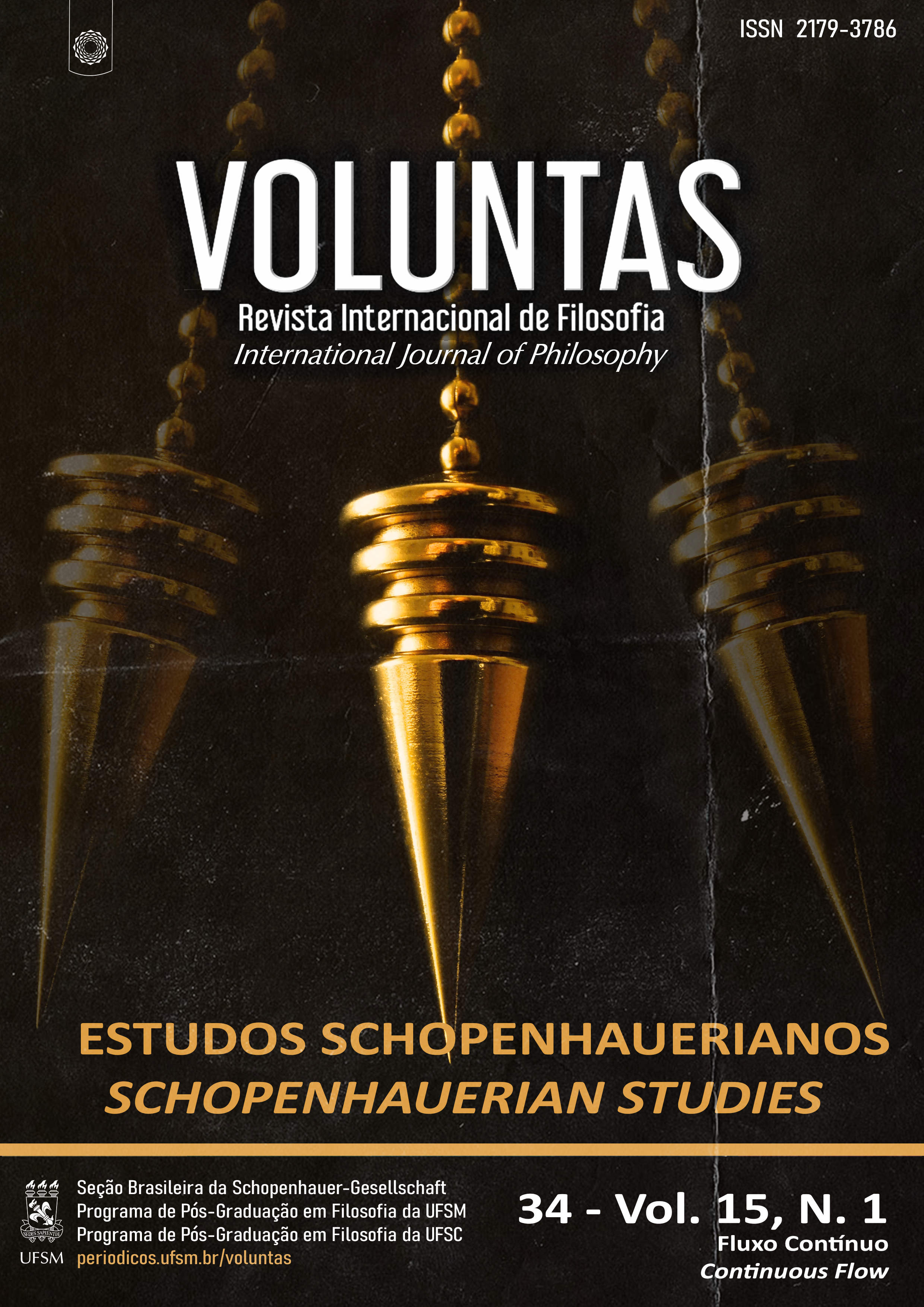
Publicado
Edição
Seção
Licença
Copyright (c) 2024 André Mário Gonçalves Oliveira

Este trabalho está licenciado sob uma licença Creative Commons Attribution-NonCommercial-ShareAlike 4.0 International License.
A submissão de originais para este periódico implica na transferência, pelos autores, dos direitos de publicação impressa e digital. Os direitos autorais para os artigos publicados são do autor, com direitos do periódico sobre a primeira publicação. Os autores somente poderão utilizar os mesmos resultados em outras publicações indicando claramente este periódico como o meio da publicação original.
A Voluntas é um periódico de acesso aberto sob a licença Creative Commons Atribuição-NãoComercial-CompartilhaIgual 4.0 Internacional (CC BY-NC-SA 4.0).