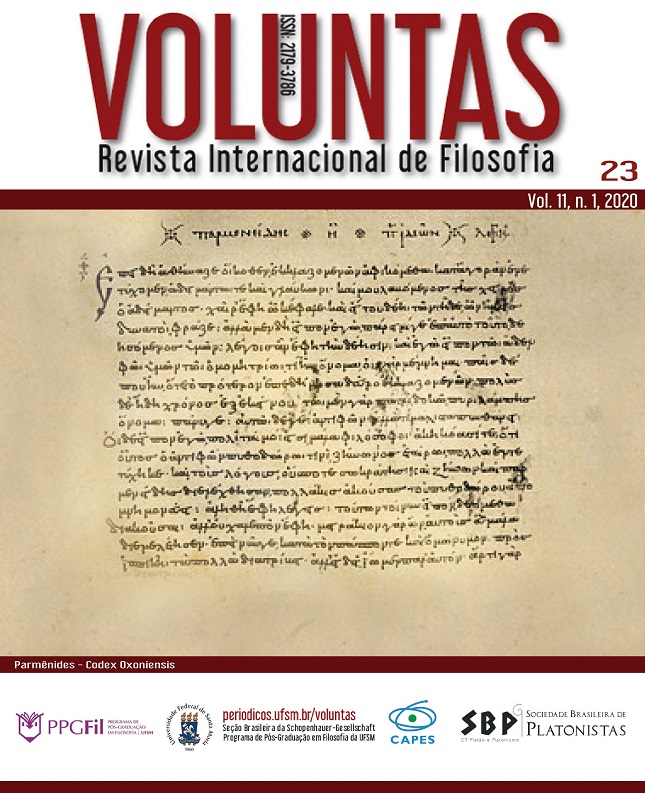
Plato’s “Parmenides” revisited
DOI:
https://doi.org/10.5902/2179378643269Schlagworte:
Parmenides, Impurity of the Sensibles, Purity of the Forms, Participation, DeductionsAbstract
Plato’s Parmenides is a notoriously challenging dialogue. To provide a completely satisfying interpretation of it, each argument needs to be reconstructed on its own terms and if all the reconstructions are accurate, the logical interconnections among the arguments of both parts of the dialogue should reveal the overall message of the Parmenides. Here I would like to summarize my interpretation, and consider a few prominent objections and alternatives to it, particularly as they appear in the work of Constance Meinwald and Mary Louise Gill. I want to explain why Meinwald’s interpretation is significantly less persuasive than mine and, because Gill and I reach similar conclusions, I want to highlight the important differences between our interpretations.Downloads
Literaturhinweise
GILL, M. L. Philosophos: Plato’s Missing Dialogue. Oxford: Oxford University Press, 2012.
GILL, M. L. Introduction to Plato: Parmenides. Indianapolis/Cambridge: Hackett Publishing Company, 1996, pp. 1-123.
MEINWALD. C. C. Plato’s Parmenides. New York: Oxford University Press, 1991.
MEINWALD. C. C. Good-bye to the Third Man, In: KRAUT, R. (ed.). The Cambridge Companion to Plato. Cambridge: Cambridge University Press, 1992, pp. 365-396.
MEINWALD. C. C. How Does Plato’s Exercise Work?, Dialogue, 53, 2014, pp. 465-494.
PETERSON, S. Plato’s Parmenides: A Principle of Interpretation and Seven Arguments, Journal of the History of Philosophy 34, 1996, pp. 167-192.
PETERSON, S. The Language Game in Plato’s Parmenides, Ancient Philosophy, 20, 2000, pp. 19-51.
PETERSON, S. New Rounds of Exercise in Plato’s Parmenides, Modern Schoolman, 80, 2003, pp. 245-278.
PETERSON, S. The Greatest Difficulty for Plato’s Theory of Forms: The Unknowability Argument of Parmenides 133c-134c, Archiv für Geschichte der Philosophie, 63, 1981, pp. 1-16.
RICKLESS, S. How Parmenides Saved the Theory of Forms, Philosophical Review, 107, 1998, pp. 501-554.
RICKLESS, S. Plato’s Forms in Transition. Cambridge: Cambridge University Press, 2007.
RICKLESS, S. Plato’s Parmenides, The Stanford Encyclopedia of Philosophy (Spring 2016 Edition), Edward N. Zalta (ed.), URL = https://plato.stanford.edu/archives/spr2016/entries/plato-parmenides/
SAYRE, K. Plato’s Late Ontology: A Riddle Resolved. Princeton: Princeton University Press, 1983.
SAYRE, K. Parmenides’ Lesson: Translation and Explication of Plato’s Parmenides. South Bend: University of Notre Dame Press, 1996.
VLASTOS, G. The Third Man Argument in the Parmenides, Philosophical Review, 63, 1954, pp. 319-349.
Veröffentlicht
Ausgabe
Rubrik
Lizenz
Die Einreichung von Originalen an diese Zeitschrift impliziert seitens der Autoren die Übertragung der Rechte zur gedruckten und digitalen Veröffentlichung. Die Urheberrechte für die publizierten Artikel liegen beim Autor, wobei der Zeitschrift das Recht zur Erstveröffentlicheng zukommt. Die Autoren dürfen dieselben Resultate in anderen Publikationen verwenden, wenn sie deutlich auf unsere Zeitschrift als ursprüngliches Publikationsmedium hinweisen.
Lizenz
Creative Commons Namensnennung - Nicht-kommerziell - Weitergabe unter gleichen Bedingungen 4.0 International (CC BY-NC-SA 4.0).