Discovering the Quarta Colônia Geopark: an experience report in non-formal spaces with undergraduate students in Social Communication - Advertising at UFSM
DOI:
https://doi.org/10.5902/2447115189288Keywords:
Non-formal educational spaces, Geoparque Quarta Colônia, Advertising teaching, Publicity creation, Advertising campaignAbstract
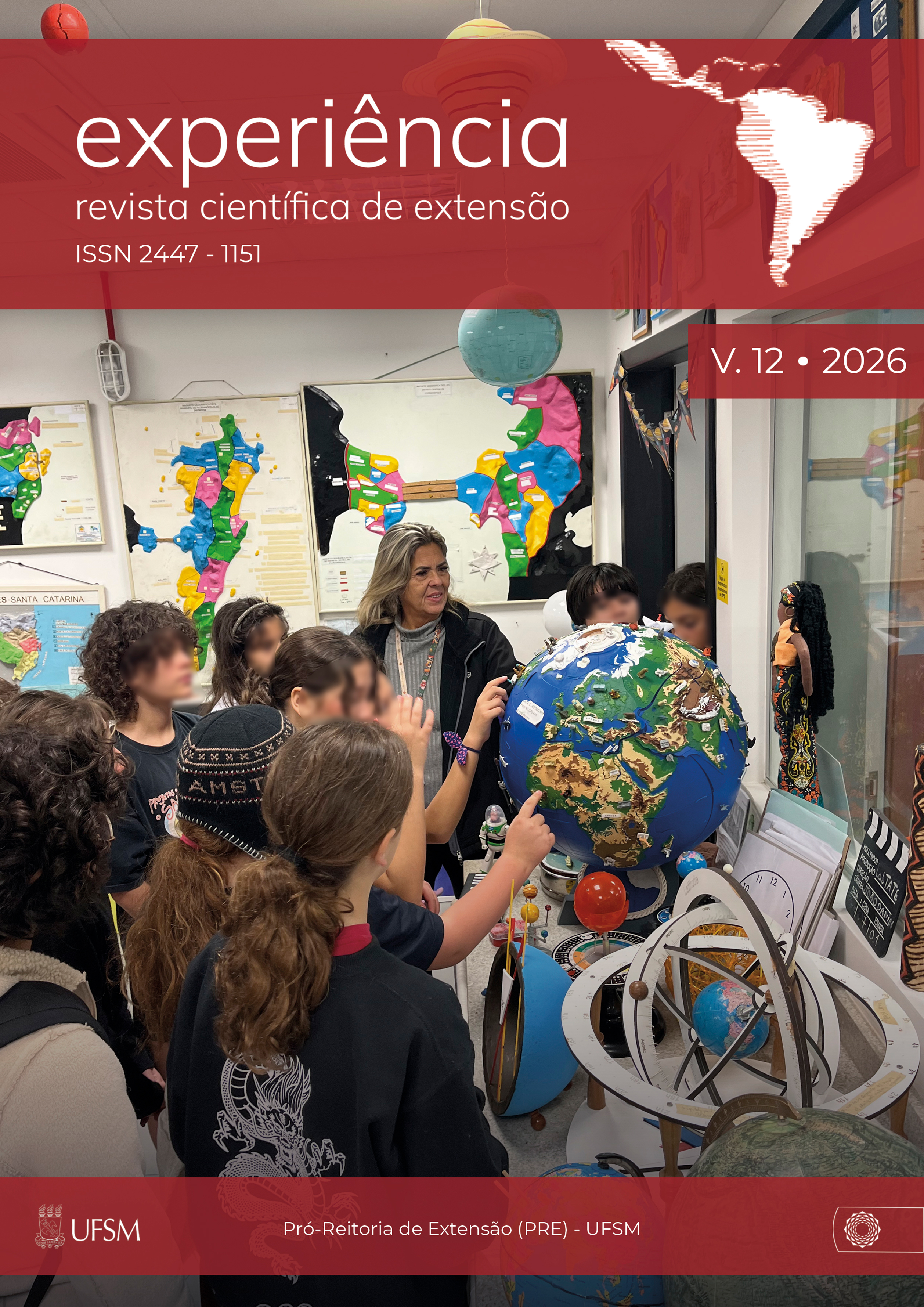
This work presents a methodological experience of teaching in non-formal spaces, based on a guided visit in the territory of the Fourth Colony UNESCO World Geopark with students from the undergraduate course in Social Communication - Advertising at the Federal University of Santa Maria (UFSM). Audiovisual recordings and briefing were carried out in order to develop an advertising campaign for the Geopark. As results, we carried out a theoretical discussion of the concepts relating to the use of non-formal spaces in teaching practices, we detailed our experience and presented the products and advertising pieces developed by the students.
Downloads
References
ARRUDA, A. L.; ALMEIDA, C. A.; COSTA, I. F.; ALMEIDA, L. A. M. O; LUZ, N. A.; SANTOS, V. C. S. Espaços não-formais na educação. Revista Ibero-Americana de Humanidades, Ciências e Educação. São Paulo, vº. 7, nº. 9, p. 1370-1380, set. 2021. Disponível em: https://periodicorease.pro.br/rease/article/view/2360. Acesso em: 20 nov. 2022.
BARRON, B., & DARLING-HAMMOND, L. (2008). Teaching for meaningful learning: A review of research on inquiry-based and cooperative learning (PDF). Powerful Learning: What We Know About Teaching for Understanding. San Francisco, CA: Jossey-Bass. Disponível em: http://www.sciepub.com/reference/93445. Acesso: 22 nov. 2022.
BLIKSTEIN, P. (forthcoming in 2011). O mito do mau aluno e porque o Brasil pode ser o líder mundial de uma revolução educacional. In: Nakahodo, S. (Ed.). Brasileiros Globalizados. Disponível em: http://www.blikstein.com/paulo/book.html. Acesso em: 20 nov. 2022.
DELORS, Jacques e outros. Educação: um tesouro a descobrir – 5ª ed. – São Paulo: Cortez: Brasília, DF: MEC: UNESCO, 2001.
FARIA, R. L; JACOBUCCI, D. F. C.; Oliveira, R. C. Possibilidades de ensino de botânica em um espaço não-formal de educação na percepção de professoras de ciências. Revista Ensaio. Belo Horizonte, vº. 13, nº. 01, p. 87-104, jan-abr, 2011. Disponível em: https://periodicos.ufmg.br/index.php/ensaio/article/view/33633. Acesso em: 20 nov. 2022.
GOHN, M. G. Educação Não-formal, Aprendizagens e Saberes em Processos Participativos. Revista Investigar em Educação, nº 1, 2014. Disponível em: https://epale.ec.europa.eu/sites/default/files/gohn_2014.pdf. Acesso em: 20 nov. 2022.
HANSEN, Fábio; PETERMANN, Juliana; CORREA, Rodrigo. Criação Publicitária: desafios no ensino. Porto Alegre: Sulina, 2020.
PRADO, Ana. Entendendo o aluno do XXI: e como ensinar a essa nova geração. São Paulo: Geekie, 2015. E-book.
REIS, E. F.; SOUSA, M. F. C.; ALVES, D. S.; PINHO, M. I. M.; RIZZATTI, I. M. Espaços não formais de educação na prática pedagógica de professores de ciências. Revista REAMEC. Cuiabá - MT, vº. 7, nº. 3, p. 23-36, set-dez, 2019. Disponível em: https://periodicoscientificos.ufmt.br/ojs/index.php/reamec/article/view/8265. Acesso em: 20 nov. 2022.
SOFFNER, R. K. (2020). Competências do Século 21. Pesquisa e Debate em Educação, 4(1), 15–31. Disponível em: https://periodicos.ufjf.br/index.php/RPDE/article/view/31994. Acesso: 22 out. 2022.
VIANNA, Maurício et al. Design Thinking: Inovação em negócios. Rio de Janeiro, MJV Press, 2012. E-book.
YARZÁBAL, L. Consenso para el cambio en la educación superior. Caracas: Unesco, IESALC, 1999.
Downloads
Published
Issue
Section
License

This work is licensed under a Creative Commons Attribution-NonCommercial-ShareAlike 4.0 International License.