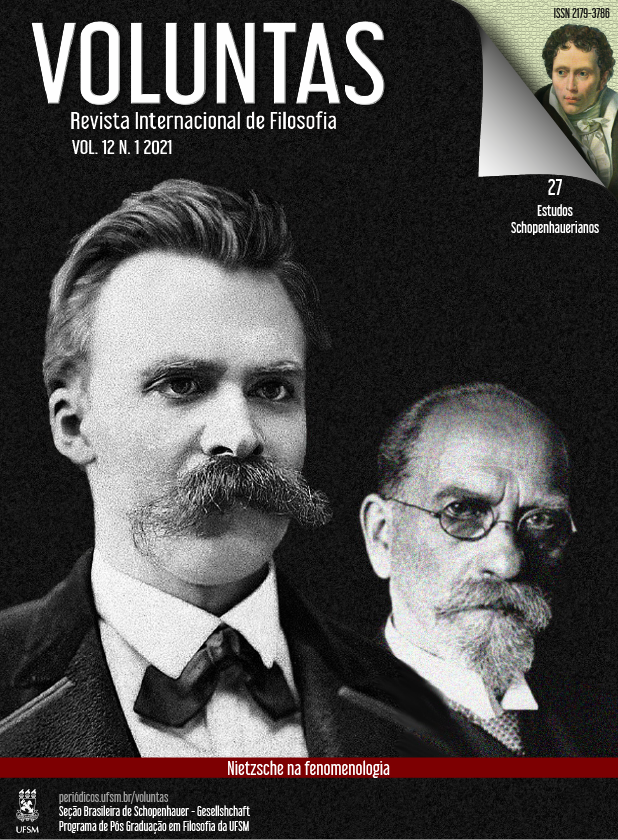
Near things: leisure time and rest. Phenomenology of idleness in Friedrich Nietzsche
DOI:
https://doi.org/10.5902/2179378664543Keywords:
Nietzsche, Phenomenology, Leisure time, Rest, Everyday lifeAbstract
Nietzsche was aware of the importance of living in the moment; both outdated and a product of his times, he tells us plainly not to be a John-a-dreams, to look around and see clearly how men live each day. In his slighting, plain-spoken judgements and his impassioned polemics, Nietzsche constantly shows how attentive an observer he is of the reality and problems of his time; it is difficult to find a topic on which he has not expressed his opinion. His attention rests on those small themes that make up the rhapsodic existence, public and private, of those who live in modern society, all small realities which, as Nietzsche himself observes, are very badly observed by most people and very rarely given much attention by a philosophy that is still too far-removed and detached from the reality of everyday life, an abstract, academic philosophizing that is hypocritically interested only in the most important things and the great questions but inevitably ends up with the neglect of what is human. Nietzsche, on the other hand, believes he has a keen eye for the smallest and most everyday things, and always succeeds in the difficult enterprise of viewing the familiar as a problem. These near things also include leisure time and rest.
Downloads
References
AA.VV. Nichts Besseres zu tun. Über Muße und Müßiggang. Oelde: Tewes, 1993.
ADORNO, Theodor Wiesengrund. Minima moralia. Torino: Einaudi, 1994.
ANDERS, Günther. L’uomo è antiquato. I. Considerazioni sull’anima nell’epoca della seconda rivoluzione industriale. Torino: Bollati Boringhieri, 2006.
CANTONI, Remo. Umano e disumano. Milano: IEI, 1958.
DE GRAZIA, Sebastian. Of Time, Work and Leisure. New York: The Twentieth Century Fund, 1962.
DE MARTINO, Giulio. Stanchi del lavoro. Apologie dell’ozio. Napoli: Intra Moenia, 2007.
DE MARTINO, Giulio. Ars vivendi. L’ozio degli antichi. Napoli: Intra Moenia, 2007.
GÖDDE, Günter. „Das beschauliche Element in großem Masse verstärken“. Zu einer Theorie der Muße bei Friedrich Nietzsche, in AA.VV., Nichts Besseres zu tun, pp. 77-95.
HEIDEGGER, Martin. Nietzsche. Milano: Adelphi, 1994.
HORKHEIMER, Max - ADORNO, Theodor Wiesengrund. Dialettica dell’illuminismo. Torino: Einaudi, 1997.
JASPERS, Karl. Nietzsche. Introduzione alla comprensione del suo filosofare. Milano: Mursia, 1996.
KAUFMANN, Walter. Nietzsche. Filosofo, psicologo, anticristo. Firenze: Sansoni, 1974.
LEOPARDI, Giacomo. Il sabato del villaggio, in Canti. Milano: Garzanti, 1999.
LOSURDO, Domenico. Nietzsche, il ribelle aristocratico. Biografia intellettuale e bilancio critico. Torino: Bollati Boringhieri, 2004.
LÖWITH, Karl. Da Hegel a Nietzsche. La frattura rivoluzionaria nel pensiero del secolo XIX. Torino: Einaudi, 2000.
MCGINN, R.E. Nietzsche on Technology, in «Journal of the History of Ideas», 4 (1980), pp. 679-691.
MORAVIA, Sergio. Itinerario nietzscheano. Napoli: Guida, 1985.
NEGRI, Antimo. Nietzsche. Storia e cultura. Roma: Armando, 1978.
NEGRI, Antimo. La potenza “esoneratrice” della tecnica e il sabato, in AA.VV. Il lavoro. Ricerca su problemi teorici e pratici del lavoro nella nostra società, III. Brescia: Morcelliana, 1987, pp. 201-231.
NEGRI, Antimo. Filosofia del lavoro, Milano: Marzorati, 1980-1981.
NEGRI, Antimo. Nietzsche nella pianura. Gli uomini e la città. Milano: Spirali/Vel, 1993.
NIETZSCHE, Friedrich. Cinque prefazioni per cinque libri non scritti, III, in La filosofia nell’epoca tragica dei Greci e scritti 1870-1873. Milano: Adelphi, 1991.
NIETZSCHE, Friedrich. David Strauss, l’uomo di fede e lo scrittore. Milano: Adelphi, 1991.
NIETZSCHE, Friedrich. Sull’utilità e il danno della storia per la vita. Milano: Adelphi, 2009.
NIETZSCHE, Friedrich. Human, All too Human. I. Cambridge University Press, 1996.
NIETZSCHE, Friedrich. Human, All too Human. II. Stanford University Press, 2013.
NIETZSCHE, Friedrich. Daybreak. Cambridge University Press, 1997.
NIETZSCHE, Friedrich. The Gay Science. Cambridge University Press, 2001.
NIETZSCHE, Friedrich. Beyond Good and Evil. Cambridge University Press, 2002.
NIETZSCHE, Friedrich. Ecce homo. Milano: Adelphi, 1992.
NIETZSCHE, Friedrich. L’anticristo. Milano: Adelphi, 2004.
NIETZSCHE, Friedrich. Frammenti postumi, 1881-1882. Milano: Adelphi, 1965.
NIETZSCHE, Friedrich. Frammenti postumi, 1882-1884. Milano: Adelphi, 1982.
NIETZSCHE, Friedrich. Frammenti postumi, 1884-1885. Milano: Adelphi, 1975.
PASQUALOTTO, Giangiorgio. Nietzsche: considerazioni attuali, in «Nuova corrente», 68/69 (1975), pp. 422-463.
PIEPER, Josef. Ozio e culto. Brescia: Morcelliana, 1956.
RIVA, Franco - SEQUERI, Pierangelo. Segni della destinazione. L’ethos occidentale e il sacramento. Assisi: Cittadella, 2009.
RIVA, Franco. Idoli della felicità. Lavoro, festa e tempo libero. Troina: Città Aperta, 2006.
RIVA, Franco. Ascesi, mondo e società, Seregno: Abbazia San Benedetto, 2003.
SCOLARI, Paolo. Nietzsche. Fenomenologo del quotidiano. Milano-Udine: Mimesis, 2013.
Published
Versions
- 2022-03-29 (2)
- 2021-05-03 (1)
Issue
Section
License
Copyright (c) 2021 Voluntas: International Journal of Philosophy

This work is licensed under a Creative Commons Attribution-NonCommercial-ShareAlike 4.0 International License.
The submission of original manuscripts to this journal implies the transference, by the authors, of the copyrights for printed and digital publication. The copyrights of a published manuscript belong ultimately to the author, and only the copyright for its first publication is reserved to the journal. Authors may only use the same results in other publications explicitly indicating this journal as the medium of the original publication.
Licence
Attribution-NonCommercial-ShareAlike 4.0 International (CC BY-NC-SA 4.0) - This license lets others remix, tweak, and build upon your work non-commercially, as long as they credit you and license their new creations under the identical terms.