
Artificial intelligence in SAR imagery: new frontiers for National Defense
DOI:
https://doi.org/10.5902/2357797596612Schlagworte:
Artificial intelligence, Synthetic Aperture Radar, Deep learning, Military innovation, National DefenseAbstract
This study examines the strategic application of Artificial Intelligence (AI) to Synthetic Aperture Radar (SAR) imagery for monitoring and protecting critical areas of national interest. Focusing on the Brazilian Air Force (FAB), it employs a qualitative and exploratory approach grounded in systematic literature review and documentary analysis. The research evaluates SVM, CNN, GAN, and Transformer models according to accuracy, adaptability, and operational relevance. The findings identify three strategic pathways—incremental refinement, synthetic data generation, and hybrid integration—demonstrating that AI–SAR convergence strengthens situational awareness, supports decision-making in strategic domains, and enhances defense capabilities essential to technological autonomy and national sovereignty.
Downloads
Literaturhinweise
AEROSPACE OPERATIONS COMMAND. Report on the Development of Computer Vision at CCOI. Brazil: Brazilian Air Force, 1 July 2025.
ARAUJO, Gustavo F.; MACHADO, Renato; PETTERSSON, Mats I. Non-Cooperative SAR Automatic Target Recognition Based on Scattering Centers Models. Sensors, v. 22, n. 3, 2022, p. 1293.
AZEVEDO, Carlos Eduardo Franco; COSTA, Gabriela Alves de Borba; ARAÚJO, Laércio Eduardo de.Challenges for the Innovation Policy in the Brazilian Defense Sector. Revista da Escola de Guerra Naval, v. 27, n. 1, 2021, p. 121–160.
BARDIN, Laurence. Análise de conteúdo. São Paulo: Edições 70, 2011.
BEZERRA, Diego Xavier. Detection of Maritime Targets from Sentinel-1 Data in an Oceanic Region Adjacent to Northeastern Brazil. 2021. Dissertação (Mestrado) – Instituto Nacional de Pesquisas Espaciais, São José dos Campos, 2021.
BRAZILIAN AIR FORCE. COMAE begins autonomous operation of the Lessonia-1 Space System. Air Force News Agency, 18 March 2025.
COSTA, Gabriela Alves de Borba; AZEVEDO, Carlos Eduardo Franco; MOREIRA, Fernando Manuel Araújo.Quantum Technology and National Defense: Opportunities and Challenges for Brazil. Boletim de Conjuntura (BOCA), v. 23, n. 67, July 2025, p. 275–299.
CRESWELL, John W. Research Design: Qualitative, Quantitative, and Mixed Methods Approaches. 5th ed. Thousand Oaks, CA: SAGE Publications, 2018.
DIETRICH, Olivier; PETERS, Torben; SAINTE FARE GARNOT, Vivien; STICHER, Valérie; TON-THAT WHELAN, Thao; SCHINDLER, Konrad; WEGNER, Jan Dirk. An Open-Source Tool for Mapping War Destruction at Scale in Ukraine using Sentinel-1 Time Series. arXiv preprint, 4 June 2024.
DOSOVITSKIY, Alexey; BEYER, Lucas; KOLESNIKOV, Alexander; WEISSENBORN, Dirk; ZHAI, Xiaohua; UNTERTHINER, Thomas; DEHGHANI, Mostafa; MINDERER, Matthias; HEIGOLD, Georg; GELLY, Sylvain; USZKOREIT, Jakob; HOULSBY, Neil. An Image Is Worth 16×16 Words: Transformers for Image Recognition at Scale. In: INTERNATIONAL CONFERENCE ON LEARNING REPRESENTATIONS (ICLR 2021).
FALQUETO, L. E.; PAES, R. L.; PASSARO, A. KNN e Rede Neural Convolucional para o Reconhecimento de Plataformas de Petróleo em Imagens SAR do Sentinel-1. Aplicações Operacionais em Áreas de Defesa, v. 24, n. 1, 2023, p. 29–33.
GOMES, João Paulo Pordeus; BRANCALION, José Fernando Basso; FERNANDES, David. Reconhecimento automático de alvos em imagens SAR utilizando-se wavelets e a classificação pela mínima distância e pelo MAP. São José dos Campos: Instituto Tecnológico de Aeronáutica; Embraer, 2015.
KELLNDORFER, Josef. Using SAR Data for Mapping Deforestation and Forest Degradation. In: FLORES, A.; HERNDON, K.; THAPA, R.; CHERRINGTON, E. (eds.). SAR Handbook: Comprehensive Methodologies for Forest Monitoring and Biomass Estimation. NASA, 2019.
KUCK, Tahisa Neitzel; SILVA FILHO, Paulo Fernando Ferreira; SANO, Edson Eyji; BISPO, Polyanna da Conceição; SHIGUEMORI, Elcio Hideiti; DALAGNOL, Ricardo. Change Detection of Selective Logging in the Brazilian Amazon Using X-band SAR Data and Pre-Trained Convolutional Neural Networks. Remote Sensing, v. 13, n. 23, 2021, p. 4944.
LEITE, B. R. de A.; HABERMANN, M. Utilização do SAR R-99 para busca marítima: metodologias e possibilidades de emprego. In: SIMPÓSIO DE APLICAÇÕES EM ÁREA DE DEFESA, 2013.
LEONARDO COMPANY. Gabbiano T-20 Radar Family – AESA Multimode Surveillance Radar Datasheet. Available at: https://electronics.leonardo.com/en/products/gabbiano-1. Access on: 28th Apr. 2025.
LINCOLN, Y. S.; GUBA, E. G. Naturalistic Inquiry. Beverly Hills: SAGE, 1985.
MESQUITA, A. S. Amazônia Azul e a FAB: uma análise prospectiva do emprego do P-3AM (Orion). Rio de Janeiro: Escola de Guerra Naval, 2012.
MEYER, Franz. Spaceborne Synthetic Aperture Radar – Principles, Data Access, and Basic Processing Techniques. In: FLORES, A.; HERNDON, K.; THAPA, R.; CHERRINGTON, E. (eds.). SAR Handbook: Comprehensive Methodologies for Forest Monitoring and Biomass Estimation. Huntsville: NASA, 2019, p. 21–44.
MINISTRY OF DEFENCE. Glossary of the Armed Forces – MD35-G-01. 5th ed. Brazil: Ministry of Defence, 2015.
MINISTRY OF DEFENCE. Strategic Space Systems Program – MD20-S-01. 1st Edition, 2018. Brasília: Joint Staff of the Armed Forces, 2018.
MINISTRY OF SCIENCE, TECHNOLOGY AND INNOVATION (Brazil). Projeto Lessônia: satélites da Força Aérea Brasileira são lançados com sucesso. Available at: https://www.gov.br/mcti/pt-br/acompanhe-o-mcti/noticias/2022/05/projeto-lessonia-satelites-da-forca-aerea-brasileira-sao-lancados-com-sucesso. Access on: 28th Apr. 2025.
MORGAN, David A. E. Deep Convolutional Neural Networks for ATR from SAR Imagery. In: PROCEEDINGS OF SPIE 9475, May 2015.
NASA EARTHDATA. Synthetic Aperture Radar (SAR). Available at: https://www.earthdata.nasa.gov/learn/earth-observation-data-basics/sar. Access on: 28th Apr. 2025.
OLIVEIRA, Thays Felipe David de; AZEVEDO, Carlos Eduardo Franco; ARAÚJO-MOREIRA, Fernando Manuel. O papel das tecnologias quânticas na disputa geopolítica entre grandes potências e seu impacto na defesa do Brasil. Boletim de Conjuntura (BOCA), v. 22, n. 65, 2025, p. 268–296.
PATTON, Michael Quinn. Qualitative Research & Evaluation Methods: Integrating Theory and Practice. Thousand Oaks, CA: SAGE Publications, 2014.
RAMSEY, Christian R. Ivy Intelligence (IVI) Large-Scale Combat Operations Targeting. Military Review Online Exclusive, November 2024, p. 7.
SAATCHI, Sassan. SAR Methods for Mapping and Monitoring Forest Biomass. In: FLORES, A.; HERNDON, K.; THAPA, R.; CHERRINGTON, E. (eds.). SAR Handbook: Comprehensive Methodologies for Forest Monitoring and Biomass Estimation. NASA, 2019.
WANG, Ying; HAN, Ping; LU, Xiaoguang; WU, Renbiao; HUANG, Jingxiong. The Performance Comparison of Adaboost and SVM Applied to SAR ATR. In: INTERNATIONAL CONFERENCE ON RADAR – CIE 2006, 2006, p. 1–4.
XIA, Junfei; ROMEISER, Roland; ZHANG, Wei; ÖZGÖKMEN, Tamay. Use of Vision Transformer to Classify Sea Surface Phenomena in SAR Imagery. IEEE Journal of Selected Topics in Applied Earth Observations and Remote Sensing, v. 18, 2025, p. 10937–10956.
ZHANG, L.; ZHANG, Y. H.; YIN, H. C.; HE, S. Y.; ZHU, G. Q. A Fast SAR Target Indexing Method Based on Geometric Models. IEEE Transactions on Geoscience and Remote Sensing, v. 57, 2019, p. 10226–10240.
ZHAO, Q.; PRINCIPE, J. C. Support Vector Machines for SAR Automatic Target Recognition. IEEE Transactions on Aerospace and Electronic Systems, v. 37, n. 2, April 2001, p. 643–654.
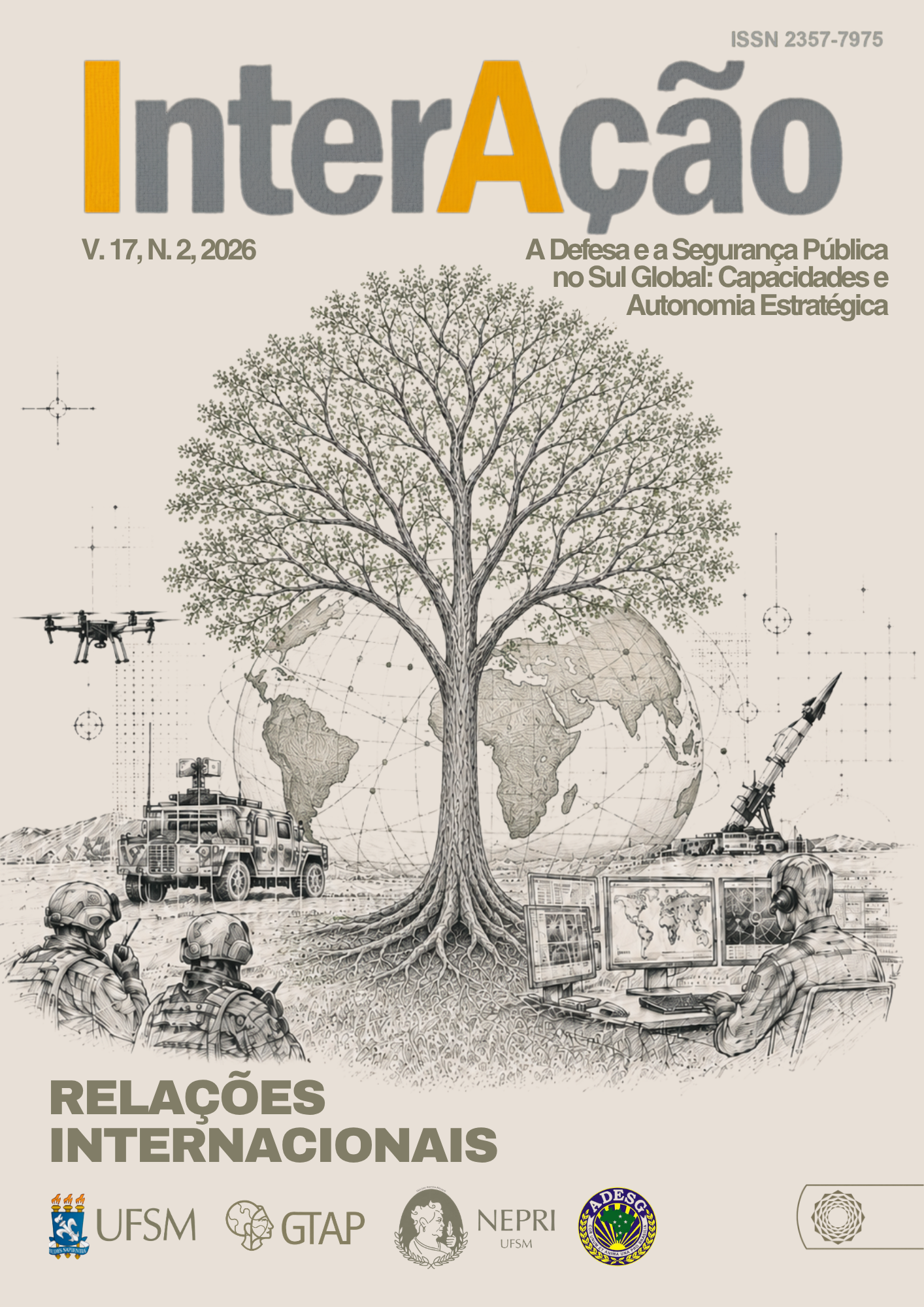
Downloads
Veröffentlicht
Ausgabe
Rubrik
Lizenz

Dieses Werk steht unter der Lizenz Creative Commons Namensnennung - Nicht-kommerziell - Weitergabe unter gleichen Bedingungen 4.0 International.


