
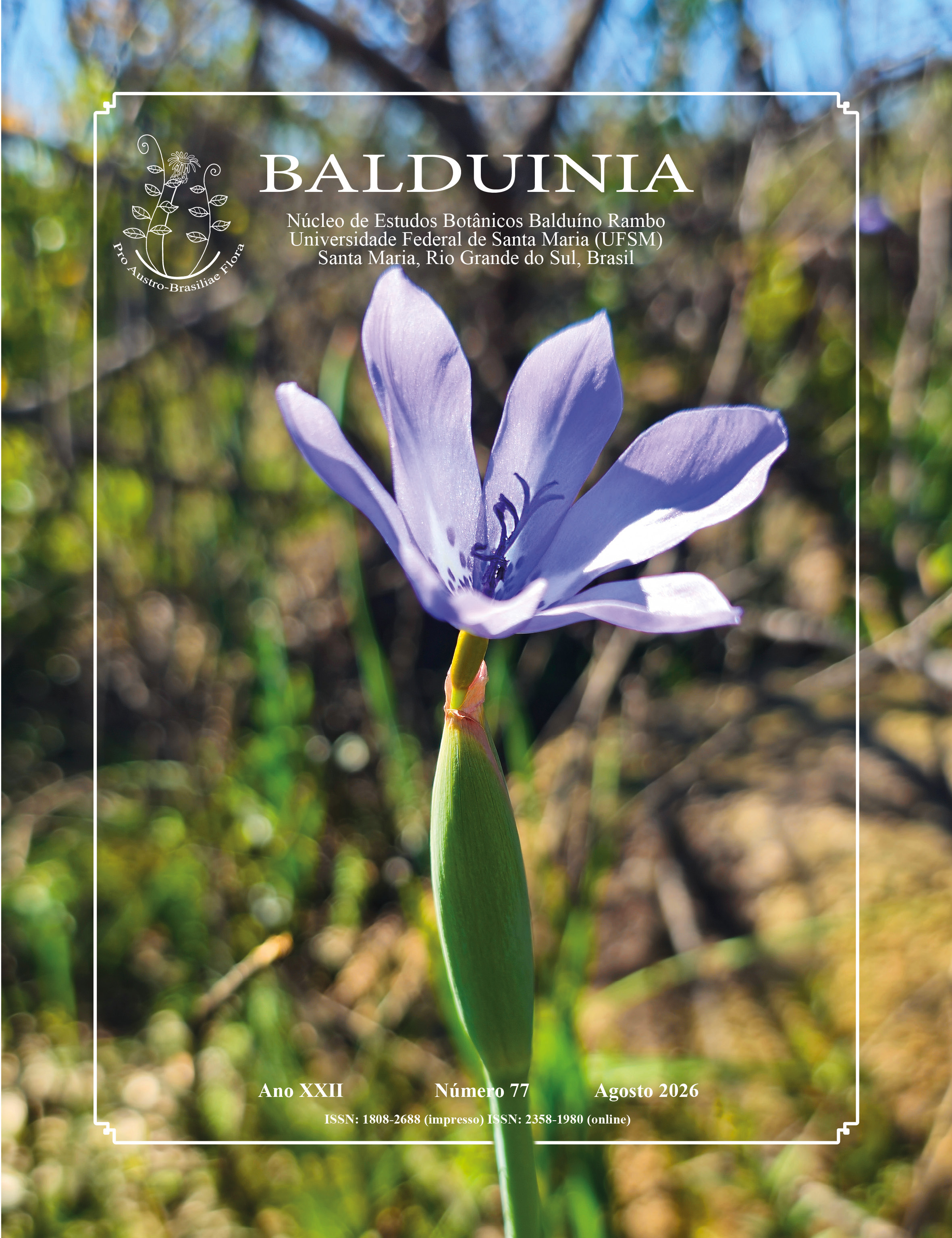
Gelasine magnifica (Iridaceae: Tigridieae), the magnificent Gelasine
DOI:
https://doi.org/10.5902/2358198098604Keywords:
Campos, São Gabriel, Suspiro locality, Taxonomy, TigridiinaeAbstract
[Gelasine magnifica (Iridaceae), the magnificent Gelasine]
A new species of Gelasine, named Gelasine magnifica, is described and illustrated for the flora of Rio Grande do Sul state (Brazil), constituting yet another endemic species for the region of the Campos, in the <Pampeana> phytogeographic province. Specimens grow on rocky outcrops of alkaline and sub-alkaline granitic formations in the locality of Suspiro, in the municipality of São Gabriel. Gelasine magnifica is close related with G. elongata; however, can be distinguished by its larger flower buds, by its bigger flowers with disciform or domed shape of the perigone, by its tepals spreading in an ascendant-oblique angle, between 15º and 30º degrees, by its stamens with longer anthers, and by its longer style, with style-branches oblique or ascendant, filiform, and subulate towards the apex, ending in a semispherical stigmatic portion. The species is considered Critically Endangered, following the criteria of IUCN.
Downloads
References
Azpiroz, A.B., Isacch, J.P., Dias, R.A., Di Giacomo, A.S., Fontana, C.S. & Palarea, C.M. 2012. Ecology and conservation of grassland birds in southeastern South America: a review. Journal of Field Ornithology 83 (3): 217-246.
https://doi.org/10.1111/j.1557-9263.2012.00372.x
Bachman S., Moat, J., Hill, A.W., de la Torre, J. & Scott, B. 2011. Supporting Red List threat assessments with GeoCAT: geospatial conservation assessment tool. ZooKeys 150: 117-126.
https://doi.org/10.3897/zookeys.150.2109
Bilenca, D. & F. Miñarro. 2004. Identificación de áreas valiosas de pastizal en las Pampas y Campos de Argentina,
Uruguay y Sur de Brasil.Buenos Aires: Fundación vida
silvestre, 353 pp.
Beentje, H. 2010. The Kew Plant Glossary: an illustrated
dictionary of plant terms. Royal Botanic Gardens, Kew,
pp.
Cabrera, Á. L. & A. Willink. 1980. Biogeografía de América
Latina. Secretaría General de la OEA, Monografía, 13,
pp.
CPRM (Serviço Geológico do Brasil). 2009. Escala 1: 15 km.
Mapa de Geodiversidade do Estado do Rio Grande do
Sul. Brasília.
Deble, L. P. 2025. Misionella (Iridaceae: Tigridieae) a new
genus from Campos eco-region of Southeast South
American grasslands. Balduinia 74: 2-21.
https://doi.org/10.5902/2358198090678
Deble, L. P., Keller, H., Pinheiro-Moreira, B., & C. Martin.
Advances towards a revision of Phalocallis: taxa
of the Southeast South American Grasslands. Balduinia
: 2-31.
https://doi.org/10.5902/2358198094820
Deble, L. P. 2026a. Gelasine aureistaminata (Iridaceae:
Tigridieae), a new species from the Cerros Chatos formations
in Uruguay and Rio Grande do Sul state, Brazil.
Balduinia 76: 25-32.
https://doi.org/10.5902/2358198095177
Deble, L. P. 2026b. Rehabilitation of the South American
genus Sphenostigma Baker (Iridaceae: Tigridieae).
Balduinia 76: 33-40.
https://doi.org/10.5902/2358198095180
Deble, L.P. & Pinheiro-Moreira, B. 2026. Um campo despretensioso.
Balduinia 77: x.
Di Giacomo, A.S. & Krapovickas, S. 2005. Conserving the
grassland important bird areas (IBAs) of southern South
America: Argentina, Uruguay, Paraguay, and Brazil.
In: Ralph, C.J. & Rich, T.D. (Eds.) Bird Conservation
Implementation and Integration in the Americas:
Proceedings of the Third International Partners in Flight
Conference 2. United States Department of Agriculture,
Forest Service, Albany, pp. 1243–1249.
Graham, R. 1830. Description of new or rare plants which
have lately flowered in the neighborhood of Edinburgh
and chiefly in Royal Botanic Garden. The Edinburgh new
philosophical journal 9: 170-178.
https://www.biodiversitylibrary.org/bibliography/33987
Goldblatt, P. & Manning, J.C. 2008. The Iris Family. Natural
History and Classification. Portland: Timber Press. 290 pp.
Herbert, W. 1840. Gelasine azurea. Azure Gelasine. Curtis’s
Botanical Magazine 66: pl. 3779.
IUCN Standards and Petitions Committee. 2012. Guidelines
for Application of IUCN Red List Criteria at Regional
and National Levels: Version 4.0. IUCN Species Survival
Commission, International Union for the Conservation
of Nature. Gland, Switzerland and Cambridge, UK. iii +
pp. https://portals.iucn.org/library/sites/library/files/
documents/RL-2012-002.pdf.
IUCN Standards and Petitions Committee. 2024. Guidelines
for Using the IUCN Red List Categories and Criteria.
Version 16. Prepared by the Standards and Petitions
Committee IUCN, Gland, Switzerland and Cambridge,
UK.. 122 pp. Downloadable from https://www.iucnredlist.
org/documents/RedListGuidelines.pdf.
Marchiori, J.N.C. 2004. Fitogeografia do Rio Grande do Sul:
Campos sulinos. Est, Porto Alegre, 110pp.
Ravenna, P.F. 1984. The delimitation of Gelasine (Iridaceae)
and G. uruguaiensis sp. nov. from Uruguay. Nordic
Journal of Botany 4: 347-350.
Ravenna, P.F. 1988. A previous valid specific epithet for
Gelasine azurea (Iridaceae). Phytologia 65 (2): 154.
Ravenna, P.F. 1989b. New species of Nothoscordum
(Alliaceae) II. Onira Botanical Leaflets 2 (5): 41-43.
Soriano, A. León, R.J.C., Sala, O.E., Lavado, R.S.,
Deregibus, V.A., Cahuepé, O., Scaglia, A., Velazquez,
C.A. & Lemcoff, J.H. 1992. Río de la Plata grasslands. In:
Coupland, R.T. (Ed.) Ecosystems of the World. Natural
Grasslands. Introduction and Western Hemisphere.
Elsevier, Amsterdam, p. 367-407.
Downloads
Published
Issue
Section
License
Copyright (c) 2026 Balduinia

This work is licensed under a Creative Commons Attribution-NonCommercial-ShareAlike 4.0 International License.
Autores que publicam nesta revista concordam com os seguintes termos:
- Autores mantém os direitos autorais e concedem à revista o direito de primeira publicação, com o trabalho simultaneamente licenciado sob a Licença Creative Commons Attribution (CC-BY-NC-SA) que permite o compartilhamento do trabalho com reconhecimento da autoria e publicação inicial nesta revista, não comercial e compartilha igual.
- Autores têm autorização para assumir contratos adicionais separadamente, para distribuição não-exclusiva da versão do trabalho publicada nesta revista (ex.: publicar em repositório institucional ou como capítulo de livro), com reconhecimento de autoria e publicação inicial nesta revista.
- Autores têm permissão e são estimulados a publicar e distribuir seu trabalho online (ex.: em repositórios institucionais ou na sua página pessoal) a qualquer ponto antes ou durante o processo editorial, já que isso pode gerar alterações produtivas, bem como aumentar o impacto e a citação do trabalho publicado (Veja O Efeito do Acesso Livre).

