Simulação e soberania cognitiva no Sul Global: dependência epistemológica e autonomia estratégica
DOI :
https://doi.org/10.5902/2357797596246Mots-clés :
Soberania cognitiva, Simulação, Sul Global, Dependência epistemológica, Autonomia estratégicaRésumé
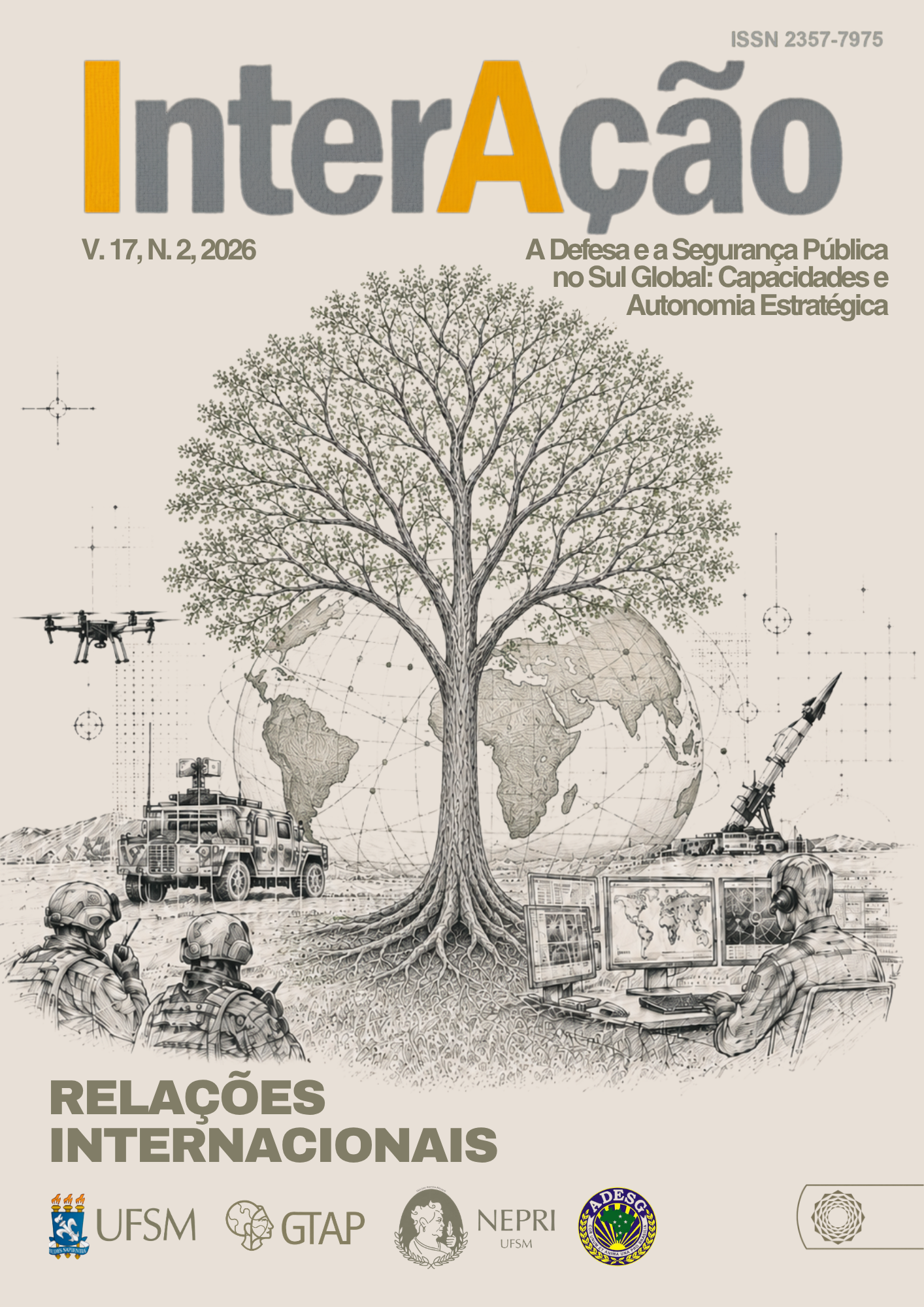
A utilização de modelagem e simulação transbordou o campo técnico e hoje dita o ritmo das decisões estratégicas em defesa, logística e políticas públicas. No entanto, há um ponto cego nessa expansão: a tendência de tratar a simulação apenas como uma ferramenta operacional de apoio. Este artigo se propõe a romper com essa visão, argumentando que a simulação atua, na verdade, como uma tecnologia epistemológica, uma infraestrutura cognitiva que molda a forma como produzimos conhecimento sobre a realidade. O problema central emerge quando países do Sul Global importam modelos e estruturas conceituais de contextos externos, o que acaba por sedimentar formas de dependência epistemológica. O argumento aqui defendido é que a soberania cognitiva depende, também, do domínio crítico dessas tecnologias. Como solução teórica, introduzo a Matriz de Soberania Cognitiva da Simulação, um framework estruturado em cinco pilares fundamentais: soberania de modelos, de dados, de ferramentas, de interpretação e de aplicação. Ao final, o texto demonstra como os jogos de guerra podem atuar como vetores práticos dessa autonomia.
Téléchargements
Références
AXELROD, Robert. The complexity of cooperation: agent-based models of competition and collaboration. Princeton: Princeton University Press, 1997.
BANKS, Jerry et al. Discrete-event system simulation. 5. ed. Upper Saddle River, NJ: Prentice Hall, 2010.
BRASIL. Ministério da Educação. Base Nacional Comum Curricular. Brasília, DF: MEC, 2018. Disponível em: http://basenacionalcomum.mec.gov.br/. Acesso em: 20 fev. 2026.
CUNHA, Guilherme Lopes et al. A (in)segurança dos oceanos, a diplomacia naval e os desafios estratégicos do Brasil. Revista de Doutrina e Jurisprudência do Superior Tribunal Militar, v. 34, n. 2, p. 1-28, 2025.
DAGNINO, Renato. Tecnologia social: contribuições conceituais e metodológicas. Campina Grande: EDUEPB; Florianópolis: Insular, 2014.
DAGNINO, Renato. Tecnociência solidária: um manual estratégico. Campinas: Unicamp, 2014.
DAVIS, Paul K. Analytic architecture for capabilities-based planning, mission-system analysis, and transformation. Santa Monica: RAND Corporation, 2002. Disponível em: https://www.rand.org/pubs/monograph_reports/MR1513.html. Acesso em: 09 mar. 2026.
DE JONG, Ton; VAN JOOLINGEN, Wouter R. Scientific discovery learning with computer simulations of conceptual domains. Review of Educational Research, Thousand Oaks, v. 68, n. 2, p. 179-201, 1998. Disponível em: https://journals.sagepub.com/doi/10.3102/00346543068002179. Acesso em: 09 mar. 2026.
EARNEST, David C. The gardener and the craftsman: four types of complexity in global life. In: KAVALSKI, Emilian (org.). World politics at the edge of chaos: reflections on complexity and global life. Albany: SUNY Press, 2015.
EDWARDS, Paul N. A vast machine: computer models, climate data, and the politics of global warming. Cambridge, MA: MIT Press, 2010.
FURTADO, Celso. Criatividade e dependência na civilização industrial. Rio de Janeiro: Paz e Terra, 1978.
GRÜNE-YANOFF, Till; WEIRICH, Paul. The philosophy and epistemology of simulation: a review. Simulation & Gaming, v. 41, n. 1, p. 20-50, 2010. Disponível em: https://journals.sagepub. com/doi/10.1177/1046878109353470. Acesso em: 10 mar. 2026.
HERRERA, Amílcar O. Los determinantes sociales de la política científica en América Latina. Redes, Buenos Aires, v. 2, n. 5, p. 117-131, 1995.
HOLLAND, John H. Complexity: a very short introduction. Oxford: Oxford University Press, 2014.
KATZENSTEIN, Peter J.; SEYBERT, Lucia A. Protean power and uncertainty: exploring the unexpected in world politics. International Studies Quarterly, v. 62, n. 1, p. 80-93, 2018. Disponível em: https://academic.oup.com/isq/article/62/1/80/4768385. Acesso em: 09 mar. 2026.
KATZENSTEIN, Peter J. Worldviews in world politics. In: KATZENSTEIN, Peter J. (ed.). Uncertainty and its discontents: worldviews in world politics. New York: Cambridge University Press, 2022. p. 1-69.
KAVALSKI, Emilian (org.). World politics at the edge of chaos: reflections on complexity and global life. Albany: SUNY Press, 2015.
LAW, Averill M. Simulation modeling and analysis. 5. ed. New York: McGraw-Hill, 2015.
MELGAREJO, Erlei Roldan. Simuladores: explorando todos os mundos. Santa Maria: UICLAP, 2023.
MAZZEGA, Pierre; DEVI, Rugmini; BARROS-PLATIAU, Ana Flávia. Where is the “Global South” located in scientific research? Earth System Governance, v. 25, 100269, 2025. Disponível em: https://doi.org/10.1016/j.esg.2025.100269. Acesso em: 10 mar. 2026.
MODI, Narendra. Prime Minister Shri Narendra Modi’s Opening Remarks at the Inaugural Leaders’ Session of Voice of Global South Summit 2023. 2023. Disponível em: https://www. mea.gov.in/Speeches-Statements.htm?dtl/36109. Acesso em: 13 fev. 2026.
MORGAN, Mary S. Experiments versus models: new phenomena, inference and surprise. Journal of Economic Methodology, v. 12, n. 2, p. 317-329, 2005. Disponível em: https://doi. org/10.1080/13501780500086128. Acesso em: 09 mar. 2026.
PERLA, Peter P. The art of wargaming: a guide for professionals and hobbyists. Annapolis: Naval Institute Press, 1990.
PUSTILNIK, Marcelo Vieira; MELGAREJO, Erlei Roldan; MILLANI, Maria Luiza Xavier. KreskaBot: ambiente virtual de robótica educacional para aprendizagem baseada em simulação. In: SUMARIVA, Guilherme (org.). Robótica, inovação e educação: conexões para o futuro. Santo André: V&V Editora, 2026.
SABIN, Philip. Simulating war: studying conflict through simulation games. London: Continuum, 2012.
SANTOS, Boaventura de Sousa; MENESES, Maria Paula (org.). Epistemologias do Sul. São Paulo: Cortez, 2010.
SARGENT, Robert G. Verification and validation of simulation models. Journal of Simulation, v. 7, n. 1, p. 12-24, 2013. Disponível em: https://doi.org/10.1057/jos.2012.20. Acesso em: 23 fev. 2026.
SQUIRE, Kurt. Video games and learning: teaching and participatory culture in the digital age. New York: Teachers College Press, 2011.
TOLK, Andreas. Engineering principles of combat modeling and distributed simulation. Hoboken: John Wiley & Sons, 2012.
VALENTE, José Armando. Integração do pensamento computacional no currículo da educação básica. Revista e-Curriculum, São Paulo, v. 14, n. 3, p. 864-897, 2016. Disponível em: http://www. redalyc.org/articulo.oa?id=76647706006. Acesso em: 09 fev. 2026.
WINSBERG, Eric. Science in the age of computer simulation. Chicago: University of Chicago Press, 2010.
Téléchargements
Publié-e
Numéro
Rubrique
Licence

Cette œuvre est sous licence Creative Commons Attribution - Pas d'Utilisation Commerciale - Partage dans les Mêmes Conditions 4.0 International.