
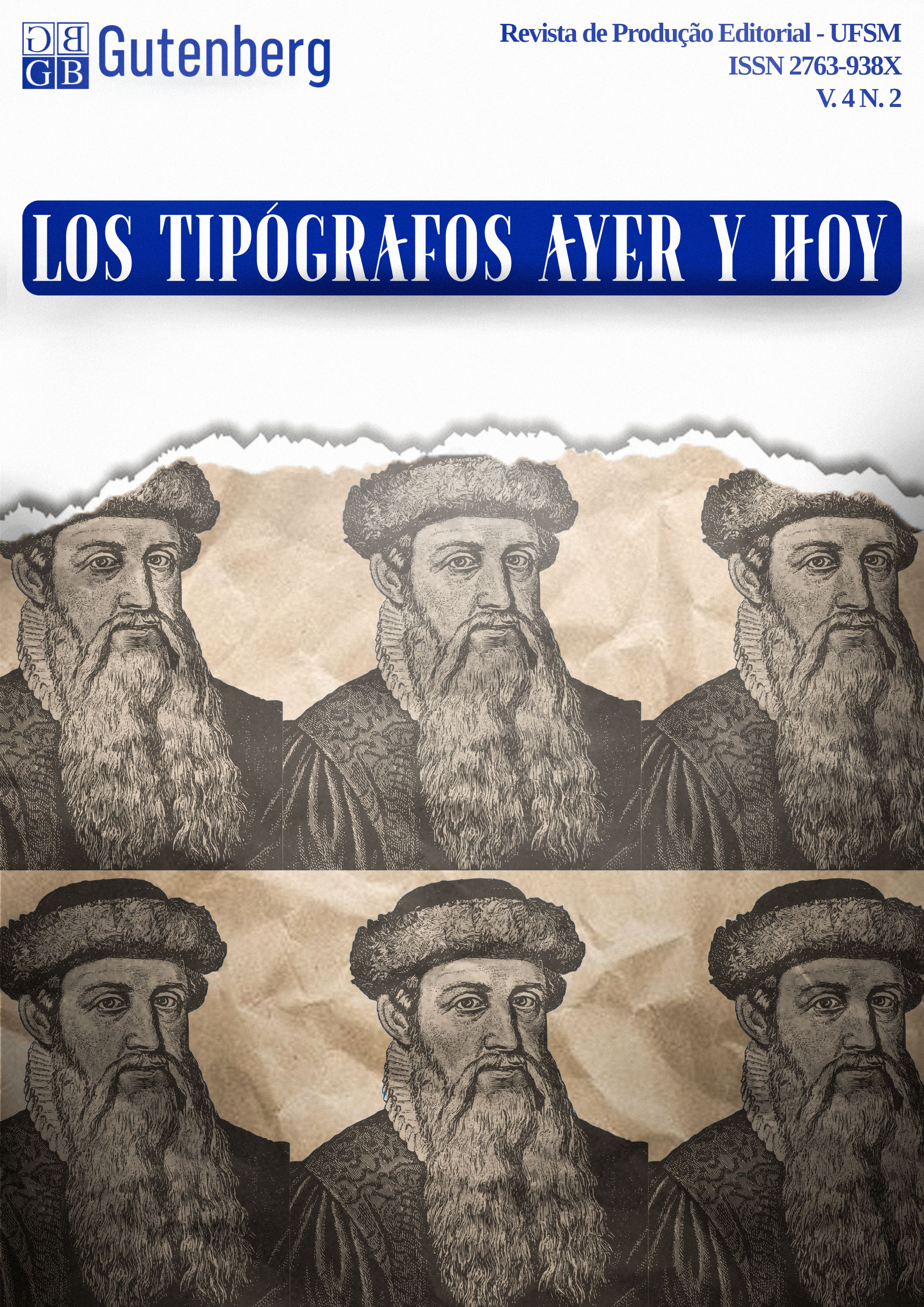
Recognition of training modalities in graphic arts through the accounts of typographers. Colombian case, 1950-2000.
DOI:
https://doi.org/10.5902/2763938X86939Keywords:
Education, Graphic arts, Craftsmanship, Industry, SENA, ColombiaAbstract
This article examines the learning processes in the sphere of graphic arts through the study of two training models identified in the accounts of a group of workers from three southwestern Colombian cities. Through structured interviews focused on elicit life narratives, the study seeks to connect, within the array of personal narratives, spatial, temporal, and discursive interconnections related to the transformations of the world of graphic arts in the period from 1950 to 2000, coinciding with the period of work activity of the interviewees. The result of the study shows the adoption of localized strategies that enabled groups of printers to negotiate the terms of introduction of technological advancements in printing, employing a mix of traditional and modern training modalities.
Downloads
References
CANALES, Manuel (ed.). Metodologías de investigación social. Introducción a los oficios. Santiago: Lom Ediciones, 2006.
CORBETTA, Piergiorgio. Metodología y técnicas de investigación social. Madrid: McGraw Hill, 2007.
DUQUE, María. Legislación gremial y prácticas gremiales: los artesanos de Pasto (1796-1850). Historia Crítica, vol. 1, n. 25, 2003, 115-136. Enlace: https://doi.org/10.7440/histcrit25.2003.07 Fecha de consulta: 20 de feb. de 2024.
GARCÍA CANCLINI, Néstor. Culturas Híbridas. Estrategias para entrar y salir de la modernidad. Barcelona: Paidós, 2001.
GEERTZ, Clifford. Conocimiento local. Ensayos sobre la interpretación de las culturas. Barcelona: Paidós, 1994.
HIGUERA, Tarcisio. La imprenta en Colombia. Bogotá: Instituto Nacional de Provisiones. ANALPRO, 1970.
HIGUERA, Tarcisio. Artes gráficas. En CANAL RAMÍREZ, Gonzalo y CHALARCA, José. (Coord.). Enciclopedia del Desarrollo Colombiano, Vol. II. Bogotá: Canal Ramírez-Antares, 1973.
MAYOR, Alberto; QUIÑONES, Cielo; BARRERA, Gloria y TREJOS, Juliana. Las escuelas de artes y oficios en Colombia 1860-1960: el poder regenerador de la cruz. Vol. 1. 1. ed. Bogotá: Editorial Pontificia Universidad Javeriana, 2014.
MORERA, Esteban. El camino a la especialización espacial: el asentamiento de la industria de las artes gráficas en el barrio San Nicolás. Santiago de Cali, 1940-1980. Memoria y Sociedad, v. 20, n. 41, 2016, 92-107. Enlace: https://revistas.javeriana.edu.co/index.php/memoysociedad/article/view/17734. Fecha de consulta: 20 de feb. de 2024 .
NIEVA, José. El SENA: un legado de Rodolfo Martínez Tono. Rutas de formación: prácticas y experiencias, n. 1, 2015, 82-89. Enlace: https://revistas.sena.edu.co/index.php/rform/article/view/234 Fecha de consulta: 22 de feb. de 2024.
MONTOYA, Omar. Schumpeter, innovación y determinismo tecnológico. Scientia Et Technica, vol. 10, n. 25, 2004, 209-213. Enlace: https://www.redalyc.org/pdf/849/84911685037.pdf Fecha de consulta: 23 de feb. 2024.
PANIAGUA, Jesús. La enseñanza profesional en el mundo colonial: la enseñanza y desarrollo de los oficios. Revista Historia de la Educación Colombiana, vol. 8, no. 8, 2005, 77-115. Enlace: https://revistas.udenar.edu.co/index.php/rhec/article/view/1089 Fecha de consulta: 23 de feb. de 2024.
PAZ, Francisco (Presbítero). Monografía de la Comunidad Mariana en Popayán. 1889 - 1989. 1. ed. Popayán: Talleres Editoriales del Departamento, 1989.
RODRÍGUEZ, Diana. El trabajo artesanal en Santafé durante la primera mitad del siglo XVII. Sastres, zapateros y sombrereros. Tesis de Maestría. Bogotá: Universidad de los Andes, 2015. Enlace: https://repositorio.uniandes.edu.co/bitstream/handle/1992/12861/u703701.pdf?sequence=1 Fecha de consulta: 20 de feb. 2024.
SALAS, Carlos. Artesanado en Pasto, 1896–1920: significado e instrucción. Revista Historia de la educación colombiana, Vol. 16, n. 16, 2013, 63–89. Enlace: https://revistas.udenar.edu.co/index.php/rhec/article/view/1740 Fecha de consulta: 20 de feb. 2024.
SANDOVAL, Laura y PLAZAS, Hugo. Tipógrafos de oficio, transformaciones de imprentas en tres ciudades colombianas. 1 ed. Pasto: Editorial Universidad de Nariño, 2022. Enlace: https://sired.udenar.edu.co/7441/ Fecha de consulta: 20 de feb. 2024.
SANDOVAL, Laura. Tipografías y tipógrafos, acervo tipográfico de la Universidad del Cauca. Popayán: Sello Editorial Universidad del Cauca, 2024.
TABARES, Juliana y CORREA, Santiago. Tecnología y sociedad: una aproximación a los estudiossociales de la tecnología. Revista Iberoamericana de Ciencia, Tecnología y Sociedad, Vol. 9, n. 26, 2014, 129-144. Enlace: https://www.redalyc.org/pdf/924/92430866007.pdf Fecha de consulta: 23 de feb. de 2024.
TOULLIOU, Claude. Historia de las artes gráficas en Pasto (1837-2015). Pasto: Empresa editora
de Nariño, 2015.
VELANDIA, Daniel. Antropología del trabajo e historia social. El mundo del trabajo en las imprentas de Colombia. Revista latinoamericana de antropología del trabajo, vol. 1, n. 2, 2017, 2-22. Enlace: https://ojs.ceil-conicet.gov.ar/index.php/lat/article/view/249 Fecha de consulta: 23 de feb. de 2024.
VELANDIA, Daniel. Imprentas en la era neoliberal. Biografía colectiva del trabajo en las artes
gráficas en Bogotá. 1. ed. Bogotá: Universidad Nacional de Colombia, 2019.
Downloads
Published
Issue
Section
License

This work is licensed under a Creative Commons Attribution-NonCommercial-ShareAlike 4.0 International License.


