Balduinia tem nova edição publicada
2026-01-21

The journal Balduinia was conceived in 2004, initially as the "Bulletin" of the Department of Forestry Sciences Herbarium of the Federal University of Santa Maria, being first published in January 2005. From its third number onwards, given a demand for a ISSN registration, the periodical moved to the category of "journal".
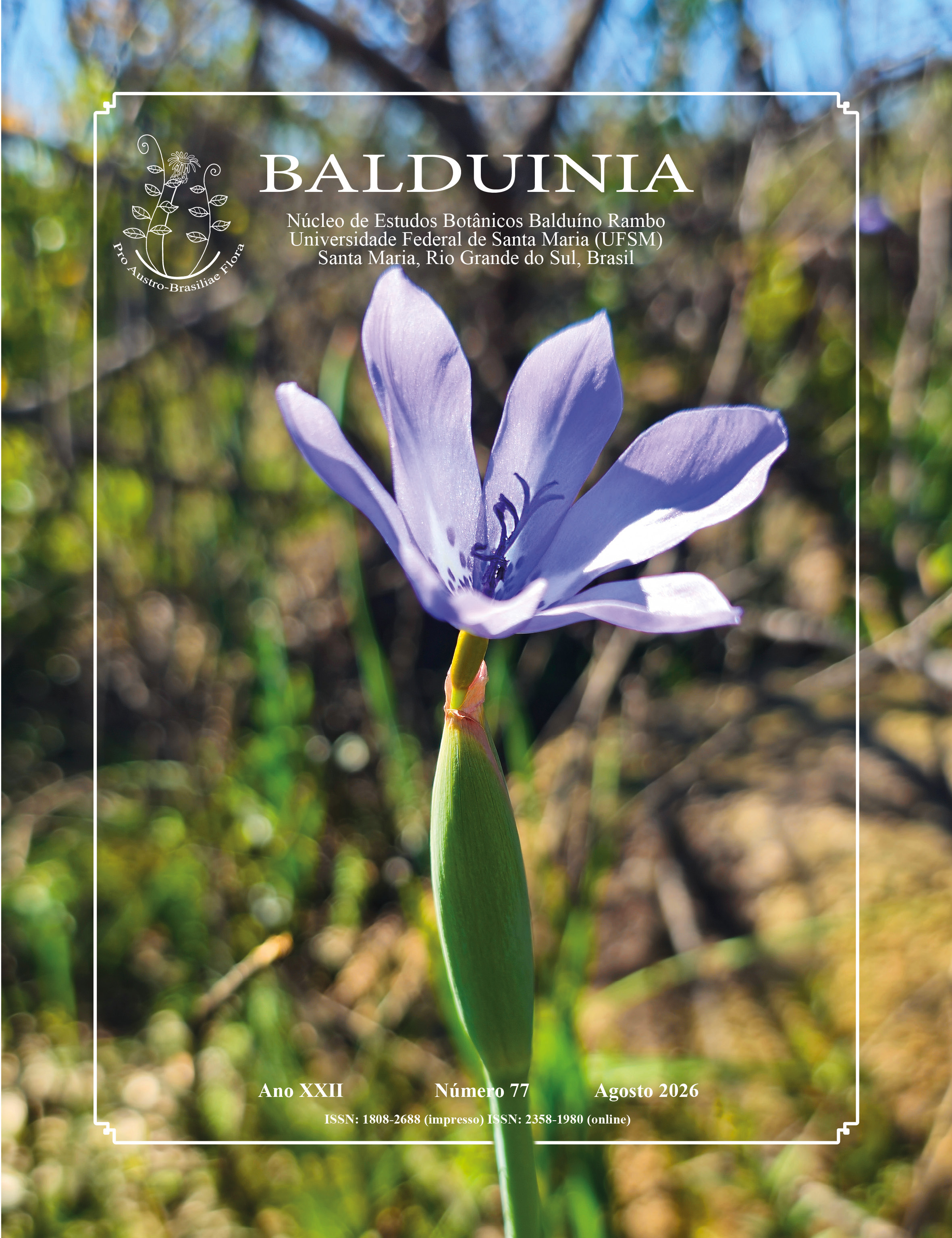
Gelasine magnifica prosperando em relictos pampeanos, localidade de Suspiro, município de São Gabriel, RS.
Foto: Bárbara Pinheiro Moreira, 2025.
The journal's name pays homage to the gaucho priest Balduíno Rambo, one of the most important botanic and phytogeographist of Brazil in the 20th century. Since its conception, the objectives of Balduinia remain the same, expressed in the back cover of its first volume: "contribute to the knowledge of the south-brazilian flora with original publications in the areas of Vegetal Taxonomy, Floristics and Anatomy of Wood".
In September 2012, the journal was relocatted on the structure of the Forestry Sciences Department of UFSM, movinjg from "Herbarium" to "Nucleous of Botanical Studies Balduíno Rambo", created by the Departmental Collegiate, on 13th of September of 2011 (record 04/11), as a "interinstitutional group of researchers that dedicate themselves to the study of south-brazilian flora, vegetation and phytogeography, specially the 'pampa' biome".

Balduinia (2005-)
eISSN 2358-1980
DOI: 10.5902/23581980
Qualis/CAPES (2021-2024) = B3

Balduinia – ISSN 2358-1980
E-mail: deble.biol@gmail.com
 Este trabalho está licenciado sob uma licença Creative Commons Attribution-NonCommercial-ShareAlike 4.0 International License.
Universidade Federal de Santa Maria, Campus Sede
Editora Central de Periódicos da UFSM
Av. Roraima, nº 1000. Cidade Universitária. Bairro Camobi.
Prédio 30, Biblioteca Central, Sala 202/205, 2º Pavimento.
Santa Maria, RS. Brasil.
CEP: 97105-900
E-mail: centraldeperiodicos@ufsm.br
Sala Virtual de Atendimento: https://meet.google.com/chp-xyxw-kfp (das 8h30min às 12h)